World Cup and Continental finals

When Italian referee Nicola Rizzoli was appointed for the Euro 2016 semi-final France-Germany, which implied his absence from the final, there were discussions regarding the missed opportunity for Rizzoli to become the first referee who was given the honour of officiating all major finals. Indeed, no referee had done yet the World Cup, Euro, Olympic, Champions League and Europa League finals. Collina missed the Euro final, Petignat missed the Olympic final, while Rizzoli missed both the Euro and Olympic finals. However, there are six (five men and one woman) referees who have officiated a World Cup final and a Continental final: Gottfried Dienst (SUI), Sergio Gonella (ITA), Romualdo Arppi Filho (BRA), Arnaldo Cezar Coelho (BRA), Said Belqola (MAR), Nicole Petignat (SUI). Among them, Dienst (photo) refereed a World Cup final, a Euro final and two Champions Cup finals.


World Cup + Continental finals
Gottfried Dienst (SUI): World Cup 1966 and Euro 1968
Sergio Gonella (ITA): World Cup 1978 and Euro 1976
Romualdo Arppi Filho (BRA): World Cup 1986 and Copa America 1987
Arnaldo Cezar Coelho (BRA): World Cup 1982 and Copa America 1979
Said Belqola (MAR): World Cup 1998 and African Cup of Nations 1998
Nicole Petignat (SUI): Women’s World Cup 1999 and Women’s Euro 2001

World Cup + Olympic finals
Pierluigi Collina (ITA): World Cup 2002 and Olympic Games 1996
Bibiana Steinhaus (GER): Women’s World Cup 2011 and Olympic Games 2012

Olympic + two continental finals
Ramon Baretto (URU): Copa America 1975, 1979 and Olympic Games 1976

Two continental finals
Michel Vautrot (FRA): Euro 1988 and Asian Cup 1988

Continental + Olympic finals
Mark Clattenburg (ENG): Euro 2016 and Olympic Games 2012
Arthur Ellis (ENG): Euro 1960 and Olympic Games 1952
Dagmar Damkova (CZE): Women’s Euro 2009 and Olympic Games 2008

Two Olympic finals
John Lewis (GBR): 1908 and 1920

If we consider the club (UCL, UEL) finals in Europe, Gottfried Dienst (SUI) and Pierluigi Collina (ITA) stand out, both with two national teams finals and two club finals. On the women's side, Nicole Petignat (SUI) refereed three finals.

World Cup + Continental + Club finals
Gottfried Dienst (SUI): WC 1966, Euro 1968, UCL 1961 and 1965
Nicole Petignat (SUI): WWC 1999, Women’s Euro 2001, UWCL 2007

World Cup + Olympic Games + Club finals
Pierluigi Collina (ITA): WC 2002, OG 1996, UCL 1999, UEL 2004

World Cup + Club finals
Nicola Rizzoli (ITA): WC 2014, UCL 2013, UEL 2010
Sandor Puhl (HUN): WC 1994, UCL 1997, UEL 1993
John Taylor (ENG): WC 1974, UCL 1971
Kateryna Monzul (UKR): WWC 2015, UWCL 2014
Cristina Ionescu (ROU): WWC 2003, UWCL 2004

Continental + Club finals
Michel Vautrot (FRA): Euro 1988, Asian Cup 1988, UCL 1986, UEL 1985
Nicolae Rainea (ROU): Euro 1980, UCL 1983, UEL 1978
Markus Merk (GER): Euro 2004, UCL 2003, 
Pedro Proenca (POR): Euro 2012, UCL 2012,
Mark Clattenburg (ENG): Euro 2016, UCL 2016, 
Ortiz De Mendibil (ESP): Euro 1968, UCL 1969
Arthur Holland (ENG): Euro 1964, UCL 1963
Arthur Ellis (ENG): Euro 1960, UCL 1956
Bruno Galler (SUI): Euro 1992, UEL 1984
Dagmar Damkova (CZE): Women’s Euro 2009, OG 2008, UWCL 2011 and 2006

UEFA Euro Final 2016: Clattenburg (ENG)

Refereeing the Portugal - France game will complete a remarkable seven weeks for Mark Clattenburg, during which he has officiated at the FA Cup and UEFA Champions League finals. The UEFA Referees Committee has announced that Mark Clattenburg will referee Sunday's UEFA Euro 2016 final between Portugal and France at Saint-Denis. The 41-year-old, who also officiated at the UEFA Champions League final in May, becomes the second man to take charge of both major European football occasions in the same season after Pedro Proença in 2012. Former electrician Clattenburg was also in the middle for May's FA Cup final. An international referee since 2007, Clattenburg's CV includes the 2012 Olympics final and 2014 UEFA Super Cup. He is the first English referee of a Euro final since Arthur Ellis (1960) and Arthur Holland (1964) presided over the first two continental national-team deciders. This is Clattenburg's fourth appointment of UEFA EURO 2016, following Belgium - Italy, Czech Republic - Croatia and Switzerland - Poland. He was also a fourth official when Iceland played Austria, his one previous UEFA-assigned fixture at the Stade de France.


10 July 2016
France – Portugal
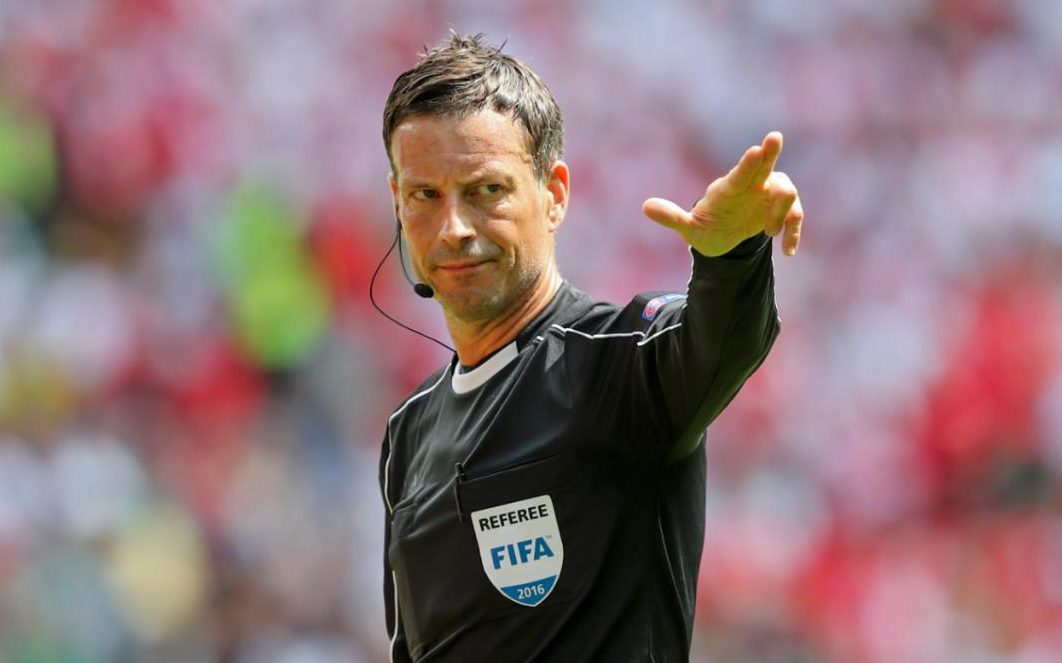
Referee: Mark Clattenburg (ENG, photo)
Assistant Referee 1: Simon Beck (ENG)
Assistant Referee 2: Jake Collin (ENG)
Additional AR 1: Anthony Taylor (ENG) 
Additional AR 2: Andre Marriner (ENG)
Fourth Official: Viktor Kassai (HUN)
Reserve AR: György Ring (HUN)
Referee Observer: Pierluigi Collina (ITA)

Clattenburg could complete historic refereeing treble

Mark Clattenburg will surely now complete a unique treble and referee Sunday’s European Championship final, despite the FA not being his biggest fan, wrote former World Cup referee Graham Poll for the Daily Mail.
Clattenburg is only at these finals due to the support of UEFA refereeing supremo Pierluigi Collina who rates him as the best in Europe. The FA are not big fans of him and insisted that Martin Atkinson went as England’s referee. However, Collina picked Clattenburg and that faith has been repaid with three excellent performances which must now result in the ultimate European appointment. Clattenburg was also appointed to the FA Cup final and Champions League final earlier this summer but the game on Sunday will surpass both of those occasions.

Source: Graham Poll/Daily Mail

Verbist replaces Allaerts as referee coordinator in Belgium

Johan Verbist is the new referee coordinator at the Royal Belgian Football Association (URBSFA). He replaces Paul Allaerts, who resigned in order to become the general manager of the first division club Mouscron. Verbist is a former international referee. Between 1996 and 2016 he was active at the highest level in Belgium. Until 2010 he was on the FIFA List and he was elected the Belgian Referee of the Year in 2004 and 2014. "It is a real honor for me to get this opportunity", Verbist (photo) said in the press release. "With all the employees of the Refereeing Department we will use our experience to offer our referees the opportunity to work in the best conditions in order to see them making progress so that they can also shine at the international level".
Allaerts started to work with the Belgian Football Association in 2013 as Sporting Director. Last year he was forced to “switch” from the position of Sporting Director to Director of Refereeing, barely a week after Frank De Bleeckere was dismissed as Elite Referee & Talent Manager. For budgetary reasons, it was officially announced, but there were rumours that Allaerts tried to save his own skin at the cost of De Bleeckere. "A bolt from the blue", responded the De Bleeckere when struck. "Everyone was happy and my evaluations were positive". The referees were very pleased with the approach of De Bleeckere, which used his vast experience at European and world level. Moreover, he became a mentor and referees could talk to him on a professional and personal level. When it appeared that the Allaerts had a different approach, the atmosphere changed. The referees were mostly on their toes by the further professionalization without financial compensation, the heavier tests and additional group training. That came along with the lack of communication when Allaerts did not show the same people management skills as De Bleeckere. A delegation of top referees (Serge Gumienny, Bart Vertenten and Sebastien Delferière) organized a few meetings with Allaerts to express discontent. Also the referee union finally came to the conclusion that the situation could not last any longer, so the story ended with Allaerts resigning from the Belgian Football Association. "We want a replacement as soon as possible, preferably, someone who can teach us something with his referee experience and also help us at the international level", said Gumienny. He mentioned no name, but the most suitable candidate for the profile could be Frank De Bleeckere. "The Bleeckere? He has proven that he can teach us something". Clear, especially since the referees considered De Bleeckere as a counselor even after his resignation and were absolutely asking for a return. When De Bleeckere, now ambassador of the vanishing spray in the Belgian company Expoline, was asked whether he would look back, he responded expectantly: "That's not an issue, but I'll leave it completely open". This time he would have to get guarantees, to avoid what happened to him a year ago. Today, the Belgian Football Association announced Johan Verbist as their new referee coordinator.

Source: Hin.be

Garcia: Zidane’s red card situation was solved through teamwork

During a recent referee course, former FIFA AR Dario Garcia, who is now a referee instructor in Argentina, described how they came out with the correct decision, although the referee did not see Zidane headbutting Materazzi.
Garcia was AR1 in the final of the 2006 FIFA World Cup played in Germany. "It was teamwork in a very complicated situation, which ended up with the correct decision. There were no protagonists; it was a team effort. The fourth official (Medina Cantalejo) saw the headbutt, he told me and I gave accurate information to Horacio (Elizondo). Based on that information, he sent off Zidane, who was one of the best players in the world at that time. If the communication within our referee team would had not worked, all our good work would had fallen through the cracks", said Dario Garcia.

Source: La Arena

Ghandour: “Kassai has been the best performing referee at Euro 2016”

While there has been the usual drama from the players on the pitch, one thing that has been noticeably absent from Euro 2016 is controversial calls from referees. And as the month-long tournament approaches the semi-finals, one former Arab referee believes it is time to recognise the excellent roles the men in black — or yellow, blue or red as they also are these days — have played in the competition. Gamal Al Ghandour, the ex-Egyptian referee who officiated at Euro 2000 as a result of collaboration between the authorities for the European event and the Africa Cup of Nations, spoke to Gulf News on Monday to share his views and experience as the only Arab and first African referee to participate in a Euro event. Al Ghandour (photo), who also refereed in World Cups 1998 and 2002, held in France and South Korea and Japan, said that the officials at Euro 2016 are performing admirably.
“They are gaining confidence all the time, which goes back to UEFA’s Chief Refereeing Officer Pierluigi Collina’s work, and I believe the large number of referees participating in the tournament is creating a fierce competition among them on who will carry on till the end of the tournament which is good,” he said. Commenting on Collina’s ways of developing the relationship between referees, players and UEFA refereeing officers, Al-Ghandour said that “his ways are emanating from practice and experience, which is what such position he is filling exactly needs.” When asked about who he thinks is the best and worst performing referees currently at Euro 2016, he said: “Viktor Kassai had the best spell of them all in the matches he was in charge of and has the most experience among them. I think Cüneyt Çakır’s performance fell a little. He’s not the ref we knew in recent European tournaments who used to be the best,” he added. And on whether a European referee would still outmatch an African and an Asian referee in terms of quality, Al Ghandour said: “In terms of quality, there are referees who are just as good as European ones in Asia and Africa. The difference comes in terms of the self-confidence both African and Asian referees unfortunately lack. Confidence comes from those they deal with, those that direct them. I wish they would have that [trust]. Both Asia and Africa have refereeing lecturers of great quality, but then their role will never be as effective as that of an [refereeing] official,” he added. Al Ghandour also talked about the difference between an Arab and a European referee and said that “an Arab referee knows more in the game’s rules; he reads it more, and gives refereeing far more time than a European referee. An Arab referee’s only problem is lack of trust and that, partially, goes back to his own personality, but mainly is because of the officials responsible for him in additional to the working environment he is involved in that revolves around conspiracy that puts him in blame most of the time,” he said. “This weakens the Arab referee’s trust in himself, in despite of his visible diligence. The difference between both referees [European and Arab] is made by what they receive morally and financially. If an Arab referee was to be treated equally as the European referee, he would surpass him,” he added. However, when it comes to current technological advancements on the pitch and how helpful they are to referees, he said that “its negatives have exceeded its positives.” The former ref added: “Refereeing failed to make good use of increasing the number of officials on the pitch. I believe only the goal-line and earpiece technologies (have been) convincing to me. Anything more than these two would be an exaggeration”.

Source: Gulf News

Copa Libertadores – Semi-finals (First Leg)

6 July 2016
Sao Paulo – Atletico
Referee: Mauro Vigliano (ARG, photo)
Assistant Referee 1: Juan Belatti (ARG)
Assistant Referee 2: Gustavo Rossi (ARG)
Fourth Official: Fernando Rapallini (ARG)
Referee Observer: Jorge Larrionda (URU)

7 July 2016
Independiente del Valle – Boca Juniors
Referee: Wilmar Roldan (COL)
Assistant Referee 1: Alexander Guzman (COL)
Assistant Referee 2: Christian De la Cruz (COL)
Fourth Official: Wilson Lamouroux (COL)
Referee Observer: Wilson Seneme (BRA)

Training the Euro's 25th team

Modern-day referees are top athletes; UEFA's referee fitness expert Werner Helsen explains how he and his team have meticulously prepared the match officials for duty at UEFA Euro 2016. The days of the rotund referee, often a figure of fun for fans, are long-since past. Today's elite match officials are top-level athletes in their own right, dedicated to fitness and striving for maximum performance in the modern-day, high-pace, high-stakes game.
The 18 quintets participating at Euro 2016 were looked after by a back-up staff of five fitness coaches and six physios and masseurs, with the vastly experienced Helsen making sure at the team's helm that the referees are supported in the most professional manner. In conjunction with the referees' national associations, Helsen and his team work together with the officials throughout each season, exchanging feedback, providing constant advice and recommendations and drawing up training and fitness programmes that are in full accordance with the referees' individual needs. UEFA's annual summer and winter courses give Helsen's team the perfect opportunity to work together with the referees on-site. As a result of this dedicated care, top European referees are in prime physical and mental condition to cope with the demands of their challenging role.
The project for Euro 2016 started four years ago. Each year, Helsen's team have carried out meticulous assessments, concluding with the referee teams undertaking fitness tests at their Euro preparatory workshop in Paris in April. The tests involved two sprints of 40 metres, followed by the yo-yo intermittent recovery test, and the results were very positive. "The yo-yo intermittent recovery test is a performance test that is very familiar within professional football," Helsen explains. "From research, we know that achieving the target level of 18:2 means that elite referees are able to run two kilometres of high-intensity running, if the game asks for it. Since the yo-yo assessment was first introduced in 2012, the elite referees have showed significant progress. Compared to the testing during the past winter course in Cyprus in February," he adds, "61.1% of the match officials significantly improved their yo-yo test performance (11 out of 18), 27.8% showed the same level (five out of 18), and only two showed a temporary decrease in yo-yo performance. It is clear that these match officials are now much better prepared compared to four years ago, in particular if we consider that they are four years older!" Final preparations between April and the Euro kick-off have focused on specific six-week training plans for the referees and assistant referees, while also taking into account their European and domestic match appointments. A balance between rest and training has been essential at the business end of the season with its domestic finals and championship deciders. During this time, Helsen and his team have also been able to discuss and hear about the referees' needs via a web-based platform where the officials enter their training information, match appointments, and, eventually, any minor or major issue that may have an impact on their training regime. Continuous monitoring of the top referees started four years ago. This means that on a day-to-day basis, Helsen and his colleagues know how many hours of training the officials do, how many matches they referee in a month and what they do in terms of travelling. Tips on fluid intake and nutrition are also crucial elements in helping the referees maintain fitness and achieve maximum performance, and look the part on the pitch. Consequently, the results over the past four years since Euro 2012, when Helsen's team began specific measurements of body composition, have been impressive, with referees' body fat levels decreasing considerably. It is true now that referees look as sleek and fit as the players they are managing. "We have seen a reduction in body fat among the referees from an average of 16.7% to only 13.5% four years later," Helsen reflects. "We have given them valuable advice with respect to nutrition and fluid intake, and it is clear that they have progressed significantly." UEFA is delighted that its referees display such a professional attitude. "It is unbelievable that people who are no longer so young have worked so hard to improve their physical shape over recent years," says UEFA's chief refereeing officer Pierlugi Collina. "We are happy and proud that our top referees are so committed to keeping fit".
- UEFA.org: What amount of training and preparation would referees be asked to do in the period between the end of their domestic season and the start of the Euro?
- Werner Helsen: They face the same problems as the players. The top players who will be involved in the European Championship also play the final stages in the European club competitions and in their domestic leagues, and it is exactly the same for the referees. Maybe it is even a bigger problem for referees, because the average age of referees and assistant referees is 40. We have a huge range, with some referees being quite young, 33 for example, and some are 45-plus. This is definitely something we need to deal with, because with increasing age, there is a need for more recovery.
- UEFA.org: After the season, when match officials would normally rest and recover, they are required to produce top performances and be at maximum fitness for the EURO. Can that be difficult for a referee?
- Helsen: They need to be fit, but for such an important championship, it is also important to be fresh. In that respect, an appropriate balance between training and rest is crucial, particular towards the end of the season. And doing things other than the usual training regimes they do is also a way to keep them not only mentally fit, but also fresh. Towards the end of the six-week schedule, we have built in some days where the training volume is less and the intensity is less, just to bring them back to [us] in top fit condition.
- UEFA.org: How has your approach as a fitness expert with your team changed over the years?
- Helsen: As a sports scientist, we always look for improved ways to support our referees. It is like any coach, who thinks every day about what he can do better. One of the aspects we have changed recently is injury prevention. The level of fitness of these referees has increased over the last 10-15 years – on the one hand, they need to train very intensively to deal with the match demands, but on the other hand, they can't do too much.
- UEFA.org: Increased attention has been given to assistant referees, and they have their own specific fitness training. Why was this considered necessary?
- Helsen: It is clear now that the speed of the game has changed dramatically, not only for the referees. The speed that assistant referees need to produce is even higher than for referees. So sprinting has become much more important for them, because the high-speed running of the players and the sprints they perform has increased significantly in the last seven years. The number of high-speed runs has increased by 50 percent, and the number of sprints by 80 percent over [this period]. With respect to distance, the high-intensity running distance increased by 30%, and the sprint distance by 35%. And, of course, assistant referees need to develop their skills in line with what the match expects.
- UEFA.org: Is there a limit to how far a human being can go in terms of fitness? Do you sometimes think that the game cannot get any quicker?
- Helsen: It is a question of where the limits are of the human system. When I receive the referee files from matches, and look at their heartbeats and distance covered in the high-speed zones, and I compare it with the sheets that I receive from UEFA with the high-speed running of the players, the referee is often doing similar amounts of high-speed running (and sometimes more) compared to players who are 15 to 20 years younger. The referees' high-speed running, at their age, is really very impressive.
- UEFA.org: At UEFA Euro 2016, matches may take place in high temperatures, 35 degrees or above. How do you prepare a referee for taking charge of a match in warm weather conditions?
- Helsen: Depending on the time of the day, [such conditions] can have a major impact. The big question is how we take care of (preventive) hydration. We pay very close attention to this in the days before a game. Then, during the game, it is actually the role of the fourth official to make sure that the referee team - right from the start of the warm-up – stays hydrated until the very end of the match.
- UEFA.org: When you look at modern referees, you must be very proud to think that you have made this contribution to where they are now in terms of fitness.
- Helsen: Well, I started working for UEFA in 1999, and my first EURO was in 2000 in Belgium and the Netherlands, so this is my fifth European Championship. When I see these referees - and I am not talking about the younger referees, but the more experienced ones - and the physical image they provide – I have so much respect for what [they] do physically at their age. There is definitely major respect for them.

Source: UEFA

UEFA Euro 2016 – Semi-finals

6 July 2016
Portugal – Wales
Referee: Jonas Eriksson (SWE, photo)
Assistant Referee 1: Mathias Klasenius (SWE)
Assistant Referee 2: Daniel Warnmark (SWE)
Additional AR 1: Stefan Johannesson (SWE)
Additional AR 2: Markus Strombergsson (SWE)
Fourth Official: Szymon Marciniak (POL)
Reserve AR: Pawel Sokolnicki (POL)
Referee Observer: Marc Batta (FRA)

7 July 2016
Germany – France
Referee: Nicola Rizzoli (ITA)
Assistant Referee 1: Elenito Di Liberatore (ITA)
Assistant Referee 2: Mauro Tonolini (ITA)
Additional AR 1: Daniele Orsato (ITA)
Additional AR 2: Antonio Damato (ITA)
Fourth Official: Damir Skomina (SVN)
Reserve AR: Jure Praprotnik (SVN)
Referee Observer: Hugh Dallas (SCO)

Kuipers: “I am disappointed that we did not reach the final”

The day after he refereed the quarter-final France – Iceland, referee Björn Kuipers and his team were released by UEFA from Euro 2016. Kuipers was in charge of three matches: Germany – Poland, Croatia – Spain and France – Iceland.
“It is awful. We had the goal to reach the final and we didn’t make it. The proudness of the achievements during this tournament will maybe come later on. At the moment it’s just disappointment”, said Kuipers. The KNVB referee coordinator, Dick van Edmond: “We are proud of the achievements of Björn and his team at this tournament. They were the Dutch representation at the European Championships and had three games on the right track. Like players, referees want only one thing, and that is making the final. But Kuipers and his team can look back on an excellent tournament”.

Source: KNVB