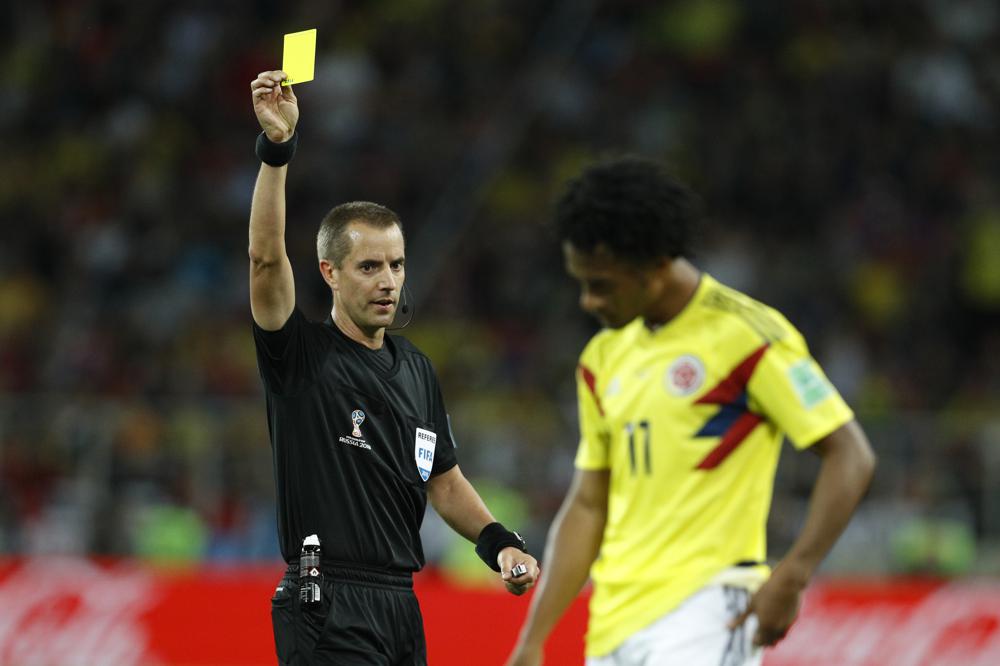
Last year, at the 2022 FIFA World Cup in Qatar, Ismail Elfath became the first American referee ever assigned to the most-watched sporting event on Earth, the World Cup Final. Elfath, whose refereeing career started with U-8 youth matches in North Austin, spoke with "The Verde Report" for over an hour about his entire 45-day experience overseeing matches on soccer's biggest stage.
- What stands out as the biggest takeaway from your World Cup experience?
- I think No. 1 is that we raised the bar and reset the view of the world of American soccer in terms of officiating. That our officials, our referees can reach the highest point in the sport. We broke a barrier that had never been broken before in terms of doing three matches, but also being on the field at the final. And then even bigger than that is that that World Cup edition was the best edition ever, in terms of what happened on the field but also off the field.
- What was it like behind the scenes in Qatar, away from the matches?
- We stayed at the FIFA headquarters hotel. It had all the amenities to make a 45-day stay comfortable. It was right next to a cultural and tourist center that had many activities that we could walk to, which is important to be able to disconnect away from the competition. We also had the chance to go to many, many matches as spectators and just enjoy it like any other fans. And then we got to experience a new culture, and Qatar did a fantastic job at breaking some misconceptions and giving a fresh, true, and very positive perspective to the Middle East.
- What went through your mind walking out of the tunnel to referee your first World Cup match?
- Well, you dream about that moment, and you play it in your head a thousand times, but there's nothing like it. The whole world stops, stands still, and I don't remember any of it! I felt like it was an out-of-body experience. But there's a moment after you line up and you take a deep breath, you take it all in and you go, "I can do this. I'm meant to do this. And I'm going to enjoy it. We're here, no one can take this away from us for the rest of our lives." Once you blow the whistle and the ball rolls, it's just like any other match.
- During that first match, Portugal vs. Ghana, you awarded a penalty kick to Cristiano Ronaldo that drew some controversy. What are your reflections of that moment?
- We were prepared. We knew how the players play, we knew the instructions from FIFA and what to focus on. And keep in mind that when you bring 40 referees from 40 countries and the teams are coming from all over the world, you have to set a standard for the tournament so there’s consistency. So, what’s a foul in Brazil might not be a foul in Germany. For that penalty, it was obviously a difficult decision because it’s happening at a high speed. For me, I had no doubt. My VAR within about 15 seconds confirmed the penalty and confirmed that the defender never touched the ball.
- All referees get criticism from fans when a decision goes against their team. Is that criticism more palpable when its an entire nation calling for your head?
- I mean, it’s the World Cup. People wait four years and nations wait sometimes decades to qualify. It wouldn’t be the World Cup that we love if it didn’t have that passion. For us as referees, we know that. We accept that. We understand that. We’re also fans of our nations as well. But what’s important is being able to be honest with ourselves for the analysis afterward. If it was a mistake we analyze it, learn from it, and move on. If it was correct, then it gives us a boost of confidence. It’s not something we expect every fan to accept or understand, but for us, it’s how we operate.
- You went viral for a moment that occurred at the end of your second match, Brazil vs. Cameroon, when Vincent Aboubakar scored late to beat Brazil and then ripped off his shirt to celebrate. Since he was already on a yellow, you had to show him a red card and send him off, but first you smiled, shook his hand, and congratulated him on the goal.
- For me personally, as a fan of the game, that was a natural moment of seeing a relatively small country score at the World Cup and a player realize a dream. You can feel the emotion. And for me, I see how happy he is, and I wanted to show him that I am human as well, and that I respected his emotion. And I think everybody understood that.
- Is that your favorite red card you've ever given?
- Not just favorite red card, it's probably my favorite moment. It's what everyone wishes the game was all about, which is respect, enjoyment, humanity, and the beauty of the game.
- Did anyone from FIFA speak with you about that moment?
- In terms of management, they were happy with our performance for the match. It was one of the highest-rated refereeing performances of the tournament. There wasn't much commentary about the red card moment, but you obviously get the feeling that FIFA really wants to humanize the referees to the audiences of the game, and that helps a little bit.
- Personally, it must have been a thrill for you to see your birth nation of Morocco become the Cinderella story of the tournament and make it all the way to the semi-finals.
- I’m surprised that I didn’t mention that when you asked me about lasting impressions. Of course, one of the biggest lasting impressions is, while Argentina might have won the World Cup trophy, Morocco won the heart of the world. So, me personally, I couldn’t help it. When we would go watch Morocco games, even though we’re the refereeing delegation and we’re expected to be neutral, I couldn’t. I cheered and I cried, and I enjoyed the moment to see the Moroccan people happy. Because I’m Moroccan before I was a referee. (
Source: Austin Chronicle)
- After you refereed both of your group stage matches, how did you learn that you'd be sticking around for the knockout stage as well?
- It's a very high-tension moment, when the appointments for the [knockout stage] matches are read out. It's in this big meeting room with 150 or 170 people, but you can hear a pin drop because people's dreams are about to be realized or not. The announcement is for who is going to remain and who is going home. FIFA does it in a really great way because if your name is called, you go up and get your medal. That means you are being released, but it's a moment to recognize what you have achieved at the World Cup. But you're sitting there waiting for your name not to be called.
- What did it mean to you, learning that you had been selected for the final as the fourth official?
- Me and my team, we had a goal. We're not going to go to Qatar to just do a game or two. We're going to try to reach the highest participation level possible, which is the final. So, for us, we did the knockout game [Japan vs. Croatia] and it went well. We knew we were in consideration. So during that period of time, the talks and the rumors and the chatter in the hallways and social media... everyone has a theory, and our name kept showing up in those theories! And that's what we wanted. Gain respect for our country, respect for our program. And then, you know, you stand in that room again and your name is read out for the final. For us it was a dream come true.
- Walk us through the day of the final as you remember it.
- The first thing, you cannot stop staring at the [referee] jersey with the World Cup final teams and stadium and date on the front and your name on the back. And then at the stadium, you're pretty much trying to slow down time and make the moment last. Of course, the moment you're walking out onto the field, you see something in front of you that you've never seen before. The World Cup trophy is right there. It's something almost surreal. But once the whistle blew, the next three hours until the end, I don't remember any of the excitement except the work I had to do, because I was busy. I was busy with the two benches, helping the referee, watching the play, helping out as much as I can. And honestly, it didn't hit me how massively exciting the game was until the next day when I was reading about it, and how epic it was.
- For those who don’t know, what is expected of the fourth official during a match?
- The No. 1 thing is you have to be ready to referee. You are given that responsibility because FIFA believes that you can handle the match if something were to happen to the referee. So, the No. 1 thing is to be mentally and physically ready to step in if needed. No. 2, you have to prepare tactically to help with refereeing the game, because you’re in between the two benches watching the match. If you have a view that the referee doesn’t have, you’re able to assist with decisions. And then you have the responsibility of managing the coaches and the players on the benches, and then obviously helping with the procedures of substitutions, injuries, etc. You’re in constant communication with the referee in terms of the game.
- From your perspective, how similar or different did the World Cup Final feel to other matches in which you’ve been the fourth official?
- It’s fundamentally no different from any other game, but the players… if you think they’re emotional during their league games, this is a World Cup Final! So, I also have to understand that there’s got to be a bit of leeway when it comes to some reactions, and sense that and feel that and manage around that. But, of course, when the line is crossed beyond acceptance, then we have to act.
- For as much as the final has been discussed all over the world, hardly any of that discussion has focused on the refereeing, except to say that it was nearly a perfectly-refereed match. What do you attribute that to?
- Well, kudos to referee Szymon Marciniak and his crew. And don’t forget that the VAR crew is also part of the team. And people don’t know that it’s really an army behind the four of us and the six of us counting the VAR and assistant VAR. The preparation that takes place is massive. For instance, we have two dedicated tactical professional coaches where that’s all they do. They don’t know anything about refereeing, they are professional soccer coaches. They help us prepare tactically for what to expect in the match, how the teams move, how play builds up, how to anticipate plays and how to be there before things happen. So, all of that makes for the performance that people get to witness. But don’t forget, it’s still the World Cup Final! So that part of it, managing the temperature of the game, we felt went really, really well. The game was always under control. And then what’s brilliant is the big decisions. Three penalties given and one potential penalty not called because it was deemed as embellishment. Those are massive calls in a World Cup Final and the referee gets them right, live, without VAR. So, what stands out is player management, technical and positional awareness, and then getting the big decisions right. And if you have those three things, no one will talk about you.
- When you last spoke to us, you talked about representing your background and your culture every time you referee a match. How much was that on your mind the day of the final?
- It's always on my mind because I see it in the mirror every day. That's why I do it, to open the door for the next person and tell them that you can do this. In refereeing, the biggest one worldwide is the notion that USA is not a soccer nation. But we are a soccer nation. There's no more any discussion that we cannot give these big assignments to U.S. referees because they're "not a soccer nation." So, I start from that perspective. And then from all other perspectives I’m passionate about in terms of who I am in the U.S. as a person of color, as a Muslim, as an immigrant, for my children, for everyone that might feel underrepresented or held back in one way or another… if I can be just a small example of putting in the work, making it hard for people to say no to you and good things will happen, if I can be that, then it means the world to me.

- Looking ahead to the next World Cup in 2026, it’s going to take place right here in the U.S., Mexico, and Canada. How much would it mean to you to referee that tournament as well?
- Well, it’s obviously something that we cannot shy away from. So that’s something that I’ll have as my goal, but as the saying goes, you have to be courageous but not arrogant. For me, it’s one game at a time, don’t take anything for granted. I have to work even harder than I did in the last cycle and let the performances take us where they may.
- This past World Cup introduced some new elements in how the games were officiated. For example, we frequently saw huge numbers of minutes added onto the end of halves in order to compensate much more accurately for injuries and stoppages. Do you expect that change to make its way to the club level any time soon?
- Yeah, for us it was a very positive thing to allow fans to experience the maximum playing time possible, because that’s what they’re there for. That’s why they watch the games, that’s why they’re in the stands, that’s why they turn on the television. We’re maximizing the actual effective playing time. And if you look at the statistics, the playing time hovers in the low 50s in some leagues. Well, at the world cup, it was a little bit over 60 minutes. And I think we should continue to push to increase that because fans want to see the ball rolling. They don’t want to see a lot of stoppages. And if there are stoppages, they should be compensated for. And hopefully it changes the behavior of certain teams and players when they might be tempted to delay. If they know that it’s all going to be added, they might as well just play.
- You’ve now felt what it’s like to work the greatest edition of the biggest game of the most popular sport on Earth. With all due respect to MLS, how do you mentally reset to referee regular season Chicago Fire vs. Real Salt Lake matches again?
- Well, I live in MLS. And because I live in MLS, MLS is very important to me. I care about the MLS games as much as I care about the FIFA games because I’ve lived through the growth. I’ve lived through the quality increase; I’ve lived through the intensity. Back in the day when I started as a fourth referee in 2009, there were quote-unquote “small games”. There’re no more small games in MLS. Every weekend, every game is big and matters. And it’s hard to referee. So, I make no mistake to say that I’m going down to an MLS game. It’s rather just going to another important match.
- In that case, what are your goals for this upcoming MLS season?
- It’s just continuing to raise the standard. Last year was a very successful year for refereeing in MLS. Now the question is, can we get another 1% better? Our accuracy rate is over 98% for the final decisions, can we get it to 99%? Can we continue to chase that illusive dream of perfection? That’s always our goal.