Belgium: FIFA referees influenced by player agent

Top Belgian FIFA referees Sebastien Delferière and Bart Vertenten had close ties with player agent Dejan Veljkovic. The newspapers of the group Mediahuis learned on Thursday about these intimate relations and the gifts that ensued. Delferière and Vertenten have been suspended with immediate effect, said Johan Verbist, the boss of the Belgian referees.
The judicial investigation that triggered an earthquake in the Belgian football community, will determine whether it is corruption. But according to the newspapers, Dejan Veljkovic's telephone conversations indicate that the agent tried to influence matches in favor of FC Malines. The investigators listened to the conversations of agents Mogi Bayat and Dejan Veljkovic for several months, according to De Standaard and Het Nieuwsblad. They discovered that Veljkovic frequently spoke with two high level referees. The Serbian agent let them know that he considered them the best by far. 
In particular, Sébastien Delferière, through Veljkovic, obtained a significant discount when he bought a car from a garage in Aalst. Veljkovic also provided him with an invitation to the gala Soulier d'Or via the newspaper Het Laatste Nieuws who organized the event. The agent invested in the football school of Mr. Delferière, now charged with participation in a criminal organization through active and passive corruption, but released under certain conditions.
Referee Bart Vertenten, meanwhile, often joined the agent's table after the matches. Veljkovic calls him his "friend". The two matches that are suspected of falsification during the 2017-2018 season are Antwerp - Eupen and FC Malines - Waasland/Beveren for which there is evidence of private corruption to rescue Malines. The investigation indicates that Dejan Veljkovic, in consultation with 4 members of the board of directors of Malines, directly or through friendly contacts, would have influenced the results of these two matches, which seems to include agreements with referee Bart Vertenten and various members of the Waasland/Beveren Board of Directors. The match between Antwerp and Eupen of the second-last matchday was mentioned, refereed by Bart Vertenten. While the Eupen were competing against Malines to avoid relegation from the first division, the referee awarded a penalty kick to Antwerp although the fault had occurred outside the penalty area. A contentious decision that allowed Antwerp to win 2-0. A week later, on the final day of the championship, decisive for the maintenance, the match Malines – Waasland/Beveren would also have been falsified. Het Laatste Nieuws also points out the contact of the agent with sports editorials of the newspaper and Het Nieuwsblad, asking journalists to offer good marks to the two referees (his "friends") in their articles. The interview of two journalists by the investigators would fit into this context.
Belgian prosecutors charged 19 people, including two referees, player agents and the coach of champions Club Bruges, with fraud or match-fixing. The offences ranged from criminal organisation to money laundering and corruption, federal prosecutors said. Nine of the 19 remained in custody, including soccer agents Dejan Veljkovic and Mogi Bayat, charged with having set up schemes to hide fees paid to themselves and to players, and referee Bart Vertenten.

Source: La Libre

UEFA Nations League – Group Stage (Matchday 3)

11-13 October 2018

League A
Poland – Portugal 

Referee: Carlos Del Cerro Grande (ESP, photo)
Assistant Referee 1: Juan Yuste Jiménez (ESP)
Assistant Referee 2: Roberto Alonso Fernández (E)
Fourth Official: Ángel Nevado Rodríguez (ESP)
Additional AR 1: Juan Martínez Munuera (ESP)
Additional AR 2: Santiago Jaime Latre (ESP)
Referee Observer: Sergey Zuev (RUS)

Belgium – Switzerland
Referee: Antonio Mateu Lahoz (ESP)
Assistant Referee 1: Pau Cebrián Devís (ESP)
Assistant Referee 2: Roberto Díaz Pérez (ESP)

Fourth Official: Diego Barbero Sevilla (ESP)
Additional AR 1: Alejandro Hernández Hernández (ESP)
Additional AR 2: José González González (ESP)
Referee Observer: Karen Nalbandyan (ARM)

Croatia – England
Referee: Felix Brych (GER)
Assistant Referee 1: Mark Borsch (GER)
Assistant Referee 2: Stefan Lupp (GER)
Fourth Official: Dominik Schaal (GER)
Additional AR 1: Marco Fritz (GER)
Additional AR 2: Harm Osmers (GER)
Referee Observer: Nuno Castro (POR)

Netherlands – Germany
Referee: Cüneyt Çakır (TUR)
Assistant Referee 1: Bahattin Duran (TUR)
Assistant Referee 2: Tarık Ongun (TUR)
Fourth Official: Serkan Ok (TUR)
Additional AR 1: Halil Umut Meler (TUR)
Additional AR 2: Barış Şimşek (TUR)
Referee Observer: Markus Nobs (SUI)

League B
Russia – Sweden
Referee: Luca Banti (ITA)
Assistant Referee 1: Lorenzo Manganelli (ITA)
Assistant Referee 2: Filippo Meli (ITA)
Fourth Official: Alessandro Costanzo (ITA)
Additional AR 1: Marco Guida (ITA)
Additional AR 2: Daniele Doveri (ITA)
Referee Observer: Ilkka Koho (FIN)

Austria – Northern Ireland
Referee: Georgi Kabakov (BUL)
Assistant Referee 1: Martin Margaritov (BUL)
Assistant Referee 2: Diyan Valkov (BUL)
Fourth Official: Georgi Todorov (BUL)
Additional AR 1: Ivaylo Stoyanov (BUL)
Additional AR 2: Nikolay Yordanov (BUL)
Referee Observer: Juan Fernández Marín (ESP)

Slovakia – Czech Republic
Referee: Slavko Vinčič (SVN)
Assistant Referee 1: Tomaž Klančnik (SVN)
Assistant Referee 2: Andraž Kovačič (SVN)
Fourth Official: Matej Žunič (SVN)
Additional AR 1: Nejc Kajtazovič (SVN)
Additional AR 2: Roberto Ponis (SVN)
Referee Observer: Murat Ilgaz (TUR)

Ireland – Denmark
Referee: Javier Estrada Fernández (ESP)
Assistant Referee 1: Javier Aguilar Rodríguez (ESP)
Assistant Referee 2: Teodoro Sobrino Magán (ESP)
Fourth Official: Íñigo Prieto López (ESP)
Additional AR 1: Ricardo de Burgos Bengoetxea (ESP)
Additional AR 2: José Munuera Montero (ESP)
Referee Observer: Sándor Piller (HUN)

League C
Israel – Scotland
Referee: Daniel Stefański (POL)
Assistant Referee 1: Marcin Boniek (POL)
Assistant Referee 2: Dawid Golis (POL)
Fourth Official: Krzysztof Myrmus (POL)
Additional AR 1: Bartosz Frankowski (POL)
Additional AR 2: Zbigniew Dobrynin (POL)
Referee Observer: Marián Ružbarský (SVK)

Lithuania – Romania
Referee: François Letexier (FRA)
Assistant Referee 1: Cyril Mugnier (FRA)
Assistant Referee 2: Mehdi Rahmouni (FRA)
Fourth Official: Nicolas Danos (FRA)
Additional AR 1: Amaury Delerue (FRA)
Additional AR 2: Nicolas Rainville (FRA)
Referee Observer: Sokol Jareci (ALB)

Montenegro – Serbia
Referee: Gianluca Rocchi (ITA)
Assistant Referee 1: Elenito Di Liberatore (ITA)
Assistant Referee 2: Mauro Tonolini (ITA)
Fourth Official: Alberto Tegoni (ITA)
Additional AR 1: Massimiliano Irrati (ITA)
Additional AR 2: Paolo Valeri (ITA)
Referee Observer: Bernardino González Vázquez (ESP)

Greece – Hungary
Referee: Tobias Stieler (GER)
Assistant Referee 1: Rafael Foltyn (GER)
Assistant Referee 2: Marco Achmüller (GER)
Fourth Official: Christian Gittelmann (GER)
Additional AR 1: Christian Dingert (GER)
Additional AR 2: Patrick Ittrich (GER)
Referee Observer: Bo Karlsson (SWE)

Estonia – Finland
Referee: Craig Pawson (ENG)
Assistant Referee 1: Lee Betts (ENG)
Assistant Referee 2: Ian Hussin (ENG)
Fourth Official: Edward Smart (ENG)
Additional AR 1: Jonathan Moss (ENG)
Additional AR 2: Christopher Kavanagh (ENG)
Referee Observer: Bertrand Layec (FRA)

Norway – Slovenia
Referee: Daniel Siebert (GER)
Assistant Referee 1: Jan Seidel (GER)
Assistant Referee 2: Eduard Beitinger (GER)
Fourth Official: Thorsten Schiffner (GER)
Additional AR 1: Felix Zwayer (GER)
Additional AR 2: Sascha Stegemann (GER)
Referee Observer: Iain Robertson Brines (SCO)

Bulgaria – Cyprus
Referee: Srdjan Jovanović (SRB)
Assistant Referee 1: Uroš Stojković (SRB)
Assistant Referee 2: Milan Mihajlović (SRB)
Fourth Official: Dragan Bogićević (SRB)
Additional AR 1: Lazar Lukić (SRB)
Additional AR 2: Zoran Široki (SRB)
Referee Observer: Cyril Zimmermann (SUI)

League D
Kosovo – Malta
Referee: Tamás Bognár (HUN)
Assistant Referee 1: Balázs Buzás (HUN)
Assistant Referee 2: Theodoros Georgiou (HUN)
Fourth Official: Péter Kóbor (HUN)
Additional AR 1: Ferenc Karakó (HUN)
Additional AR 2: Péter Solymosi (HUN)
Referee Observer: Michális Argyroú (CYP)

Faroe Islands – Azerbaijan
Referee: Aleksey Eskov (RUS)
Assistant Referee 1: Dmitri Mosyakin (RUS)
Assistant Referee 2: Anton Averianov (RUS)
Fourth Official: Valeri Danchenko (RUS)
Additional AR 1: Vladislav Bezborodov (RUS)
Additional AR 2: Mikhail Vilkov (RUS)
Referee Observer: Salustià Ciprés (AND)

Belarus – Luxembourg
Referee: Ali Palabıyık (TUR)
Assistant Referee 1: Serkan Olguncan (TUR)
Assistant Referee 2: Serkan Çimen (TUR)
Fourth Official: İbrahim Uyarcan (TUR)
Additional AR 1: Yaşar Uğurlu (TUR)
Additional AR 2: Serkan Tokat (TUR)
Referee Observer: Vadims Direktorenko (LVA)

Moldova – San Marino
Referee: Bryn Markham-Jones (WAL)
Assistant Referee 1: Daniel Beckett (WAL)
Assistant Referee 2: Gareth Jones (WAL)
Fourth Official: Lewiss Edwards (WAL)
Additional AR 1: Huw Jones (WAL)
Additional AR 2: Nicholas Pratt (WAL)
Referee Observer: Dejan Filipović (SRB)

Georgia – Andorra
Referee: Leontios Trattou (CYP)
Assistant Referee 1: Michael Soteriou (CYP)
Assistant Referee 2: Petros Petrou (CYP)
Fourth Official: Pavlos Georgiou (CYP)
Additional AR 1: Vasilis Dimitriou (CYP)
Additional AR 2: Nikolas Neokleous (CYP)
Referee Observer: Shmuel Shteif (ISR)

Latvia – Kazakhstan
Referee: Harald Lechner (AUT)
Assistant Referee 1: Andreas Heidenreich (AUT)
Assistant Referee 2: Maximilian Kolbitsch (AUT)
Fourth Official: Andreas Staudinger (AUT)
Additional AR 1: Alexander Harkam (AUT)
Additional AR 2: Markus Hameter (AUT)
Referee Observer: Oğuz Sarvan (TUR)

Armenia – Gibraltar
Referee: Fedayi San (SUI)
Assistant Referee 1: Sladan Josipovic (SUI)
Assistant Referee 2: Marco Zürcher (SUI)
Fourth Official: Bekim Zogaj (SUI)
Additional AR 1: Alain Bieri (SUI)
Additional AR 2: Lukas Fähndrich (SUI)
Referee Observer: Nicolae Grigorescu (ROU)

FYR Macedonia – Leichtenstein
Referee: Roi Reinshreiber (ISR)
Assistant Referee 1: Danny Krasikow (ISR)
Assistant Referee 2: David Biton (ISR)
Fourth Official: Amihay Mozes (ISR)
Additional AR 1: Orel Grinfeld (ISR)
Additional AR 2: Ziv Adler (ISR)
Referee Observer: Pavel Saliy (KAZ)

Concacaf Women’s Championship 2018

USA, 4-17 October 2018

Referees 

1. Marie-Soleil Beaudoin (CAN, photo)
2. Melissa Borjas (HON)
3. Carol Anne Chenard (CAN)
4. Francia Gonzalez (MEX)
5. Tatiana Guzman (NCA)
6. Odette Hamilton (JAM)
7. Ekaterina Koroleva (USA)
8. Mirian Leon (SLV)
9. Crystal Sobers (TRI)
10. Lucila Venegas (MEX)

Assistant Referees
1. Chantal Boudreau (CAN)
2. Princess Brown (JAM)
3. Enedina Caudillo (MEX)
4. Mayte Chavez (MEX)
5. Felisha Mariscal (USA)
6. Kimberly Moreira (CRC)
7. Kathryn Nesbitt (USA)
8. Shirley Perello (HON)
9. Mijensa Rensch (SUR)
10. Stephanie Yee Sing (JAM)

FIFA Women’s World Cup 2019 Qualifiers – UEFA Play-offs (Semi-finals)

First Leg, 5 October 2018

Netherlands – Denmark
Referee: Kateryna Monzul (UKR, photo)
Assistant Referee 1: Maryna Striletska (UKR)
Assistant Referee 2: Mihaela Tepusa (ROU)
Fourth Official: Lina Lehtovaara (FIN)

Belgium – Switzerland
Referee: Anastasia Pustovoitova (RUS)
Assistant Referee 1: Ekaterina Kurochkina (RUS)
Assistant Referee 2: Kylie McMullen (SCO)
Fourth Official: Monika Mularczyk (POL)

Second Leg, 9 October 2018

Denmark – Netherlands
Referee: Sara Persson (SWE)
Assistant Referee 1: Julia Magnusson (SWE)
Assistant Referee 2: Sandra Österberg (SWE)
Fourth Official: Pernilla Larsson (SWE)

Switzerland – Belgium
Referee: Jana Adamkova (CZE)
Assistant Referee 1: Lucie Ratajová (CZE)
Assistant Referee 2: Katalin Török (HUN)
Fourth Official: Katalin Kulcsár (HUN)

Top Belgian FIFA referees investigated in corruption scandal

Police carried out raids in seven countries on Wednesday as Belgian prosecutors targeted the country's biggest football clubs as part of an investigation into fraud and match-fixing. Top referees Sebastien Delferiere (photo) and Bart Vertenten are also speaking to police amid claims of match fixing, according to De Standaard. Belgian referee boss Johan Verbist follows the investigation of the federal prosecutor's office: "I am currently following everything through the media, so I cannot confirm the news", said Verbist. “I have not yet been able to contact the referees whose names are being circulated, and if they have actually been picked up, it is logical that they cannot answer any phone calls”.
A total of 220 police officers carried out 44 house searches across Belgium as well as in France, Luxembourg, Cyprus, Montenegro, Serbia and Macedonia, Belgian prosecutors said. "A great number of persons have been deprived of their liberty and taken in for a thorough interrogation", said a statement from investigators. Federal prosecutors told AFP that the arrests included well-known football agent Mogi Bayat, the former manager of Sporting Charleroi, who had been arrested in his home. Bayat, a 44-year-old Belgian-Iranian, was the main target of the probe, Belgian media reports said, along with another agent, Dejan Veljkovic, and clubs with which they did business. Club Brugge coach Ivan Leko, whose team is playing in the Champions League, was also arrested on Wednesday. The headquarters of Club Brugge, Standard Liege, Anderlecht and KRC Genk, the current leader of the Belgian Premier League, were searched in the operation. "During the investigation there were indications of possible influencing of matches in the 2017-2018 season", the prosecutors said. Some of the house searches were carried out at the homes of club directors, soccer agents, referees, a former lawyer, a trainer, journalists and at an accounting office. The searches abroad were chiefly at offices and residences of people used to set up the suspect transactions, the prosecutors said. "I am asking for full transparency and cooperation from the football world to this investigation," said Philippe Muyters, Belgium's sports minister. "The athletes and especially the numerous supporters are entitled to a fair sport", he said.

International Friendly Matches

October 2018

Wales – Spain
Referee: Anthony Taylor (ENG, photo)
Assistant Referee 1: Gary Beswick (ENG)
Assistant Referee 2: Stephen Child (ENG)
Fourth Official: Iwan Griffith (WAL)

Turkey – Bosnia and Herzegovina
Referee: Sergei Karasev (RUS)
Assistant Referee 1: Igor Demeshko (RUS)
Assistant Referee 2: Aleksei Lunev (RUS)
Fourth Official: Halis Özkahya (TUR)

Saudi Arabia – Brazil
Referee: Danny Makkelie (NED)
Assistant Referee 1: Mario Diks (NED)
Assistant Referee 2: Hessel Steegstra (NED)
Fourth Official: Dennis Higler (NED)
VAR: Jochem Kamphuis (NED)

Iraq – Argentina
Referee: Jarred Gillett (AUS)
Assistant Referee 1: Ashley Beecham (AUS)
Assistant Referee 2: Owen Goldrick (AUS)
Fourth Official: Peter Green (AUS)
VAR: Christopher Beath (AUS)

Brazil – Argentina
Referee: Felix Brych (GER)
Assistant Referee 1: Mark Borsch (GER)
Assistant Referee 2: Stefan Lupp (GER)
Fourth Official: Marco Fritz (GER)
VAR: Günter Perl (GER)
AVAR: Robert Hartmann (GER)

Albania – Jordan
Referee: Genc Nuza (KVX)
Assistant Referee 1: Fatlum Berisha (KVX)
Assistant Referee 2: Bujar Selimaj (KVX)
Fourth Official: Juxhin Xhaja (ALB)

Italy – Ukraine
Referee: Rade Obrenovič (SVN)
Assistant Referee 1: Matej Žunič (SVN)
Assistant Referee 2: Manuel Vidali (SVN)
Fourth Official: Marco Di Bello (ITA)

Scotland – Portugal
Referee: Ruddy Buquet (FRA)
Assistant Referee 1: Guillaume Debart (FRA)
Assistant Referee 2: Julien Pacelli (FRA)
Fourth Official: Clément Turpin (FRA)

Belgium – Netherlands
Referee: Artur Soares Dias (POR)
Assistant Referee 1: Rui Barbosa (POR)
Assistant Referee 2: Paulo Santos (POR)
Fourth Official: Tiago Martins (POR)

Croatia – Jordan
Referee: Sándor Andó-Szabó (HUN)
Assistant Referee 1: Zsolt Varga (HUN)
Assistant Referee 2: Oszkár Lémon (HUN)
Fourth Official: Fran Jović (CRO)

Sweden – Slovakia
Referee: Jakob Kehlet (DEN)
Assistant Referee 1: Christian Brixen (DEN)
Assistant Referee 2: Lars Hummelgaard (DEN)
Fourth Official: Anders Poulsen (DEN)

Denmark – Austria
Referee: Ola Hobber Nilsen (NOR)
Assistant Referee 1: Tom Grønevik (NOR)
Assistant Referee 2: Geir Isaksen (NOR)
Fourth Official: Rohit Saggi (NOR)

France – Iceland
Referee: Tiago Martins (POR)

UAE – Honduras
Referee: Joao Capela (POR)
Assistant Referee 1: Antonio Godinho (POR)
Assistant Referee 2: Ricardo Santos (POR)

Mexico – Costa Rica
Referee: Oscar Moncada (HON)
Assistant Referee 1: Walter Lopez (HON)
Assistant Referee 2: Melvyn Cruz (HON)
Fourth Official: Roberto García (MEX)
Referee Assessor: Jorge Gasso (MEX)

USA – Colombia
Referee: John Pitti (PAN)
Assistant Referee 1: Gabriel Victoria (PAN)
Assistant Referee 2: Christian Ramirez (HON)
Fourth Official: Hector Martinez (HON)

Peru – Chile
Referee: Armando Villarreal (USA)
Assistant Referee 1: Adam Wienckowski (USA)
Assistant Referee 2: Kyle Atkins (USA)
Fourth Official: Ted Unkel (USA)

Costa Rica – Colombia
Referee: Ismail Elfath (USA)
Assistant Referee 1: Charles Morgante (USA)
Assistant Referee 2: Adam Wienckowski (USA)
Fourth Official: Ted Unkel (USA)

USA – Peru
Referee: Ivan Barton (SLV)
Assistant Referee 1: Geovany Garcia (SLV)
Assistant Referee 2: David Moran (SLV)
Fourth Official: Ismael Cornejo (SLV)

Mexico – Chile
Referee: Joel Aguilar (SLV)
Assistant Referee 1: Juan Zumba (SLV)
Assistant Referee 2: Douglas Bermudez (SLV)
Fourth Official: Francisco Chacon (MEX)
Referee Assessor: Julio Escobar (MEX)

Borjas: “I hope to once again represent Concacaf at the World Cup”

The 2018 Concacaf Women’s Championship is off and running with three teams looking to qualify directly for the 2018 FIFA Women’s World Cup in France. The tournament is also being used to evaluate the performances of referees, including Honduran Melissa Borjas, who was one of six female referees to represent Concacaf at the 2015 FIFA Women’s World Cup in Canada.
Borjas is happy to be back refereeing matches at the highest level in Concacaf and hopes to be selected to once again represent the region at a World Cup. “It’s always exciting to participate in all of the Concacaf World Cup qualifiers, above all in the senior team tournament, where not only teams can qualify for the World Cup but also referees,” said Borjas in an exclusive interview with Concacaf.com. “My place at the 2019 World Cup in France is not assured but my preparation is being based on winning myself a place and once again representing Concacaf. It’s an arduous technical, physical and mental process day after day, month after month, but being at another World Cup is worth it,” added Borjas. Also serving as an incentive for Borjas was her time in Canada four years ago. There is no doubt that the experience served as an important lesson in her career. “To referee my first senior World Cup match was a great blessing and it allowed me to realize that what I was doing in my preparation was not sufficient to keep myself at that level and that I should work harder,” said Borjas. She also took a moment to praise the support that female referees have received from Concacaf, which has included the use of female referees in the Concacaf League and Concacaf Nations League. “I think more than an initiative, it’s a show of support for the arduous work that we do daily and above all it shows that women are capable of refereeing men’s matches,” said Borjas. Refereeing a men’s match is nothing new for Borjas, however. The 31-year-old has been on the whistle for matches in Honduran Liga Nacional, which she feels has improved her refereeing skills. “Refereeing men’s matches allows me to strengthen my personality and broaden my knowledge in regards to style of play or tactics of teams and preparing myself for each match. The truth is that calling men’s matches has a great physical demand but now it is no longer very different than women’s football because it has developed and advanced very quickly,” said Borjas. “FIFA is working very closely with each one of the confederations so that they support women’s referees on all levels. Kari Seitz has visited the most important tournaments or qualifiers of each confederation to get to know and follow up on referees and so that shows the direct support that FIFA has for women’s refereeing”, concluded Borjas.

Source: Concacaf

Copa do Brasil: 18 people appointed to referee-related duties during the final

The introduction of VAR will definitely increase the costs associated with a match. According to a document published by Arbitro Internacional, the Brazilian FA (CBF) appointed 18 people to referee-related duties for the 2018 Brazil Cup Final.

10 October 2018
Cruzeiro – Corinthians
Referee: Anderson Daronco
Assistant Referee 1: Alessandro Rocha
Assistant Referee 2: Fabricio Villarinho
Fourth Official: Bruno Araujo
Reserve AR: Rafael Alves
Field Analyst: Claudio Cerdeira
Referee Assessor: Alicio Pena
VAR: Wilton Sampaio
AVAR: Heilton Nunes
Reserve VAR: Braulio Machado
VAR Supervisor 1: Marcel Serapiao
VAR Supervisor 2: Sergio Correa
Technical Supervisor: Claudio Freitas
TV Replay Operator 1: Gutemberg Rangel
TV Replay Operator 2: Thiago Imbroisi
TV Replay Operator 3: Marcelo Castra
TV Review Assistant 1: Claudio Santos
TV Review Assistant 2: Romulo Jesus

Schörgenhofer: Dispatcher by day, FIFA referee by night

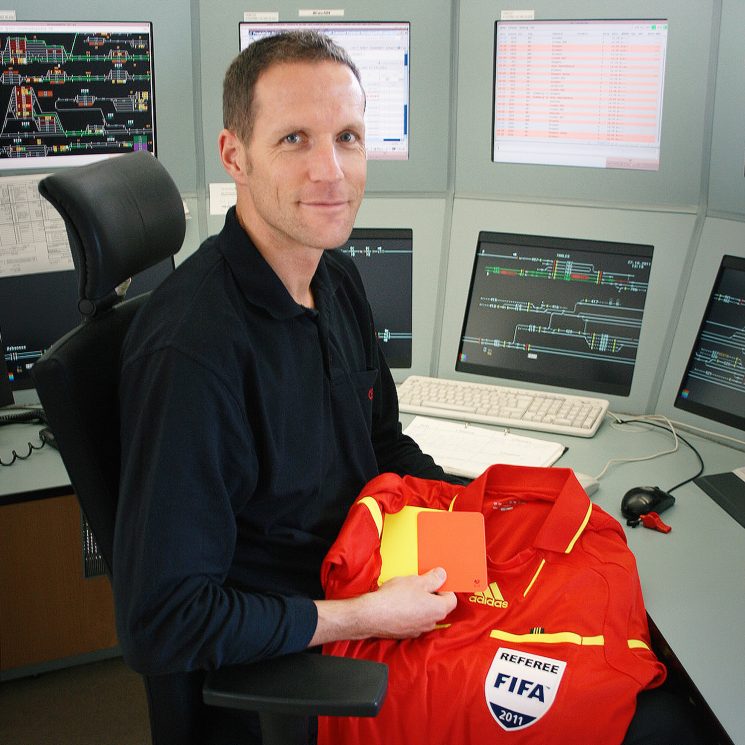
More than 100 international football matches were led by FIFA referee Robert Schörgenhofer, who is a civil service officer at the Wolfurt freight depot in ÖBB. Most recently, he whistled the match Germany-Peru. The sympathetic Vorarlberger, born in 1973, always has the full overview on the rails and on the lawn. Robert Schörgenhofer started at the ÖBB in 1988 and has been the dispatcher since 1993. We interviewed our athletic colleague and asked him about both responsible jobs.
- What is your daily work routine?
- Together with my colleagues, I ensure a safe, smooth train service/shunting in the Wolfurt freight depot and the associated remote control of the routes at the Wolfurt Central Substation. Added to this is the customer information at the stations and stops on the route.
- Mr. Schörgenhofer, how did you get into football?
- I grew up next to a sports field and I preferred to spend every free minute on the football field since kindergarten. Later I played with the club FC Sulz, from juniors to the main team.
- What motivated you to become a referee?
- Certainly, it was a wrongly received red card. By the way, the only one in my footballing career. Since we had a referee who was totally overwhelmed, I thought to myself: I can do that better. And that was the beginning of my refereeing career.
- Tell us something about your work as a referee?
- A most interesting and exciting task! In addition, an outstanding personality training. Managerial skills are as much in demand as those of a conflict solver. It is actually the best school of life. I would immediately recommend this hobby to young people. A special addition are the international assignments. If you referee games of the best footballers in the world, then you can see that as a reward for all your effort.
- As a referee you are very much in the spotlight. What attracts you to this activity?
- Every game is different, so it never gets boring. The goal is to make as few mistakes as possible. Being free of mistakes is an impossible task, but the will to do it has something of its own. On top of that, you have to keep calm in difficult situations and not let the rush of players and spectators make you feel insecure.
- Which levels have you completed since then? National, international?
- Almost all. Starting with junior games and all levels in the local association. Since 1995 assistant referee in the Bundesliga, then from 2000 referee in the 2nd Bundesliga and since 2004 referee in the 1st Bundesliga. From 2007 as FIFA referee. Among others, I participated at the U-21 European Championship in Denmark 2011 and the U-20 World Cup in Colombia, also in 2011. In addition, countless international matches, Europa League matches and three Champions League games.
- For how many years?
- I passed my referee exam in March 1991.
- Which game did you referee most recently?
- Germany – Peru.
- What does ÖBB have in common with football?
- Both move the masses. The ÖBB also acts as a sponsor of the ÖFB.
- How do you bring together two such responsible functions - that of the dispatcher and the referee?
- At this time, I can only thank the colleagues! Short-term business interruptions are compensated by them. From work, one benefits from the other. In hectic exceptional situations, I am used to keeping calm and composed. This is a win-win situation for me.
- What experience in your referee career will remain unforgettable?
- For one, the England - Wales match at the Wembley Stadium. When 80,000 people sing "God save the queen", you will inevitably get goose bumps. But also the city derby in Cairo was unique. Five hours before the start of the match, the stadium was already full and no more spectators were admitted. Officially there were 90,000 spectators, unofficially sure some more in the stadium. Unbelievable how excited the Egyptians are in terms of football.
- What is the number of matches you refereed?
- I do not have statistics about it. In the 1st Bundesliga I am at almost 200, international at 100 games.
- What were your biggest and most important games?
- I already mentioned some. Amongst others, the first Champions League match at Chelsea, a Europa League match at Liverpool, an international match of England at the Wembley Stadium, a city derby in Cairo in front of 90,000 spectators and of course the U-20 World Cup in Colombia. That's just an excerpt - the list is much longer.
- Is there personal contact with Ronaldo and Co. before or after the games?
- No. You see the players 1.5 hours before the game, in the stadium, or at the latest when warming up.
- How do you charge your batteries? Is there a special powerhouse in your home country?
- Jogging is the best "medicine" for me, since I can switch off and get the head free. Positive side effect, it is also a training session.
- What makes a good dispatcher? And which of these qualities should a referee have?
- To keep calm and overview in case of incidents or extraordinary events. Do not rush into hustle and bustle. Be capable of multi-tasking. It is no different as a referee. A situation can trigger something that requires exactly these qualities.
- One more question at the end: in professional circles you are referred to as the top referee, No. 1 in Austria. How do you deal with that?
- I think I am still the same as years ago. It does not suit my nature to put myself on a pedestal or to brag about my games. Personally, I am proud of what I already achieved as a referee. But a lot of my ambition is owed here. There is no giving up for me!

Source: OBB

Collina: FIFA is happy to help growth of VAR

At the end of the first-ever VAR Instructor course put on by FIFA in Madrid this past week, legendary referee and current Chairman of FIFA’s Refereeing Committee Pierluigi Collina spoke with FIFA.com about the importance of the event, the state of VAR and where the technology might go in the future.
- Mr. Collina, can you describe why this seminar was organised?
- It came about because FIFA received many requests from Member Associations after the success of VAR at the FIFA World Cup in Russia, and they were interested in the implementation process for their domestic competitions. At the moment it’s quite difficult to have VAR instructors because VAR is something very new. We decided to create a panel of instructors that could help implement VAR around the world. The VAR Instructor seminar was arranged this week in Madrid with some former referees and some active referees who had experience with VAR in their countries or were with us during the preparation of the 2018 World Cup.
- What did that training look like?
- Some of 40 candidates who went through the programme. It included theoretical lessons and also practical sessions with the VAR simulator, which reproduces exactly the VOR – the Video Operation Room, which is used during the match – using clips of matches already played. Then we had a practical sessions on the field with players creating planned incidents with decisions taken by the referee, who is in touch with the VOR where our instructor candidates were, so they learned how the VAR operates in a variety of situations and will be able to coach and instruct others to use the system in the future.
- Is this likely to be repeated in the future?
- At the moment, related to the specific matter of VAR, there are very few instructors capable, and we wanted to make that group bigger. In terms of the future, VAR should become even more popular, so it’s possible we will do it again based on the needs. There are several Member Associations who clearly say they are keen to start, plus Confederations, including AFC who said they will use VAR in the Asian Cup in January next year, and UEFA have said they will use it in the next Champions League. So where there is a need to prepare the referees for these competitions, we as FIFA are happy to provide support and help.
- Beyond training referees, what are the challenges for VAR?
- The Technical Innovation Department at FIFA also give support in terms of the technology. VAR has two different parts: one is the human part, and that is the referees, and one is concerning technology. And of course we are not an expert in that, and so whenever an MA wants to implement something, the Technology Innovation Department can give knowledge and expertise and advise how to deal with the challenges the MA can face Also it’s important to note that VAR is not something that works in the same way for everyone. At the World Cup we had four video match officials in the VOR while most domestic competitions use only two. There are also decentralised and centralised versions. In Russia we had one VOR in Moscow, which is similar to how it is run in Germany and Spain where it is also centralised. On the other hand, in Italy they have a decentralised version with one VOR, one room, in each venue. Also, in Russia we had more than 40 TV cameras. There are some leagues with just 12 or 13, so for the former you need more people to analyse all the angles quickly. With less cameras, you need less people. It’s something that is flexible and adaptable depending on the needs to the competition.
- How do you see VAR moving forward in terms of helping referees? Could it be expanded further?
- We have just completed an experiment this past March when the IFAB decided to include VAR in in the Laws of the Game so the history is quite short. The first time we discussed about a video technology which could have assisted referees was in November 2014, so less than four years ago. VAR is very, very young. Based on the experience we have had and continue to have, we can certainly think about amendments and adjustments in certain details, though I don’t see the big picture changing.
- What are you looking for in these instructors?
- Every instructor has to be able to communicate something which has to be understood. We are very pleased because the vast majority of the people we had at this seminar were very, very good. The quality of the people, who were pre-selected to attend, was high. The challenge for them is that VAR is still a new tool and it is still something that needs to be learned and known about at a deeper level. But at the end of the seminar, the feeling I have is very positive.

Source: FIFA