CAF Africa Cup of Nations 2021 – Group Stage (Matches 21-24)

16 January 2022

Gambia – Mali
Referee: Samir Guezzaz (MAR, photo)
Assistant Referee 1: Zakaria Brinsi (MAR)
Assistant Referee 2: Fatiha Jermoumi (MAR)
Fourth Official: Jean Ndala Ngambo (COD)
VAR: Redouane Jiyed (MAR)
AVAR: Bouchra Karboubi (MAR)

Cote d’Ivoire – Sierra Leone
Referee: Maguette N’Diaye (SEN)
Assistant Referee 1: Djibril Camara (SEN)
Assistant Referee 2: Sidiki Sidibe (GUI)
Fourth Official: Issa Sy (SEN)
VAR: Bakary Gassama (GAM)
AVAR: El Hadji Samba (SEN)

Tunisia – Mauritania
Referee: Mahmoud El-Bana (EGY)
Assistant Referee 1: Mahmoud El-Regal (EGY)
Assistant Referee 2: Ahmed Hossam (EGY)
Fourth Official: Amin Omar (EGY)
VAR: Mahmoud Ashour (EGY)
AVAR: Ahmed El-Ghandour (EGY)

Algeria – Equatorial Guinea
Referee: Mario Escobar (GUA)
Assistant Referee 1: Elvis Noupue (CMR)
Assistant Referee 2: Issa Yaya (CHA)
Fourth Official: Joshua Bondo (BOT)
VAR: Fernando Guerrero (MEX)
AVAR: Mohammed Ibrahim (SDN)

88-year-old referee hanging up his whistle after 70-year career

An 88-year-old referee has told talkSPORT now is the time to become an official as he hangs up his whistle after a glorious 70-year career refereeing the likes of Diego Maradona. Terry Farley’s venture into refereeing began back in 1952 and is still going to this day, with his final game coming at the end of January. Talking to Hawksbee and Jacobs, the officiating legend spoke about a career that has spanned seven decades and countries across Europe. The veteran also explained why now is as good a time as any to become a referee, and how he still maintains peak fitness to this day.
“On January 4, 1952 was when I first passed my referees’ examination at the headquarters of the Durham Football Association,” Farley explained. “So, on January 4, 2022 I had completed 70 years as a Durham county referee, so I thought, ‘Well, at 88 it’s time to hang up the whistle after 70 years of a career which has given me an awful lot of pleasure.’ [The game has] changed immensely, I started off in the grassroots and made my way up the progress ladder and in 1965 I received an invitation from the Football League, in those days, to become a linesman. Again I progressed until I got on the referees list in the Football League which saw me refereeing Manchester, Liverpool, et cetera. I ran the line twice at Hampden Park when Scotland played Peru and Scotland played Argentina and that’s when the name Maradona first hit the headlines and we realised what a wonderful player he was. I ran the line at Wembley in the Charity Shield, I ran the line at Barcelona and Juventus.”
After a frankly incredible career in the game, Farley is as well positioned as anyone to judge the current state of affairs in the game. Farley remembers back in his day when highlights were televised, there was far less scrutiny. “In those days when I was refereeing in the Football League we had Match of the Day and ITV did a spot as well, but of course now every game in the Premier League is analysed, VAR takes over on occasions so it’s evolved over the years.” Farley also believes that abuse directed at referees has only got worse since he started. “It’s a big issue,” he said. “Again going back to when I refereed in junior football which was quite strong in those days, generally speaking respect from the touchlines and respect from the players was good. But the amount of abuse referees get these days really is unacceptable, both on and off the field I’m afraid, that’s at grassroots level as well.”
Many will wonder how the octogenarian is still going, and he’s revealed he tries to maintain his fitness just as much as when he started out. “I’ve always been fit, I played football for the school, I was a fairly good cross country runner, I played squash, cricket, et cetera,” he said. “I’m in the gym four times a week now, I’m pretty fit, I really am. I wasn’t one for standing in the centre circle, I took pride in my fitness, obviously at 88 years of age you’re not as fit as you were. I’ve got a game coming up a week on Sunday at Durham University which will be the final one, and Tyne Tees Television are coming out too to cover me and will be the last game.” Many are put off by the abuse and scrutiny that referees are put under in the modern game, but Farley has a clear message for anyone looking to start a career. “In my view there’s never been a better time to be a referee because in my day you were pretty much on your own,” he said. “Now you’ve got coaches and mentors and observers so if you want to be a referee then now’s the time.”

Source: talkSPORT

CAF Africa Cup of Nations 2021 – Group Stage (Matches 19-20)

15 January 2022

Nigeria – Sudan
Referee: Victor Gomes (RSA, photo)
Assistant Referee 1: Zakhele Siwela (RSA)
Assistant Referee 2: Jerson Dos Santos (ANG)
Fourth Official: Boubou Traore (MLI)
VAR: Adil Zourak (MAR)
AVAR: Mostafa Akarkad (MAR)

Guinea Bissau – Egypt
Referee: Pacifique Ndabihawenimana (BDI)
Assistant Referee 1: Soulaimane Amaldine (COM)
Assistant Referee 2: Lionel Hasinjarasoa (MAD)
Fourth Official: Ahmad Heeralall (MRI)
VAR: Mustapha Ghorbal (ALG)
AVAR: Abdelhak Etchiali (ALG)

CONMEBOL: “Getting the big finals should be your goal”

During the pre-season camp, the CONMEBOL top referees will review theoretical content, technical, regulations and administrative guidelines to prepare for the CONMEBOL Libertadores, CONMEBOL Sudamericana and all other competitions scheduled for the year. 
“Since 2017, it has become an obligation of CONMEBOL to prepare our FIFA referees and this also applies to all National Associations”, said the President of the Referees Committee, Wilson Seneme. “Getting the big finals should be your goal. Getting to referee the classics and the big games, that is what you should always aim for and then celebrate it as a great achievement." Deputy Secretary General Nery Pumpido welcomed the participants and invited them to take advantage of the pre-season sessions, "which are days of great learning and shared team values". The referees invited to the pre-season camp will be evaluated through technical and fitness tests from 15 to 19 January 2022.
As part of the CONMEBOL-UEFA exchange, referees Maria Ferrieri Caputi (ITA) and Luis Godinho (POR) will attend the sessions in Paraguay, while John Ospina (COL) and Emikar Calderas (VEN) will go to the UEFA course in Cyprus.

Source: CONMEBOL

French referee Millot suspended for issues related to UEFA appointment

The French Referees Committee held a virtual hearing of FIFA referee Benoit Millot due to some travel issues related to an UEFA appointment.
Considering that it is the responsibility of a referee, who is moreover international, to take all necessary arrangements to ensure that his travel take place in the best possible way, the committee decided that, in this case, Millot failed in his duty. The shortcomings of which Benoît Millot is accused require that an administrative action is taken against him. Although the CFA appreciated Millot’s behavior adopted by during his hearing, when he did not seek to minimize his wrongs, but assumed them fully, as expected from a high-level referee, pursuant to Article 39 of the Referees Statutes, Millot was suspended from 14 December 2021 to 10 January 2022. As a consequence, Benoit Millot was removed from the VAR list of the 2021 Afcon that started on 9 January 2022, only 2 days before the end of his suspension.

Source: FFF

CAF Africa Cup of Nations 2021 – Group Stage (Matches 15-18)

14 January 2022

Senegal – Guinea
Referee: Bamlak Tessema (ETH, photo)
Assistant Referee 1: Souru Phatsoane (LES)
Assistant Referee 2: James Emile (SEY)
Fourth Official: Mario Escobar (GUA)
VAR: Samir Guezzaz (MAR)
AVAR: Fatiha Jermoumi (MAR)

Malawi – Zimbabwe
Referee: Dahane Beida (MTN)
Assistant Referee 1: Mahamadou Yahaya (NIG)
Assistant Referee 2: Samuel Pwadutakam (NGA)
Fourth Official: Salima Mukansanga (RWA)
VAR: Bouchra Karboubi (MAR)
AVAR: Zakaria Brinsi (MAR)

Morocco – Comoros
Referee: Sadok Selmi (TUN)
Assistant Referee 1: Khalil Hassani (TUN)
Assistant Referee 2: Liban Abdourazak (DJI)
Fourth Official: Peter Waweru (KEN)
VAR: Haythem Guirat (TUN)
AVAR: Mahmoud El-Bana (EGY)

Gabon – Ghana
Referee: Lahlou Benbraham (ALG)
Assistant Referee 1: Mohammed Ibrahim (SDN)
Assistant Referee 2: Seydou Tiama (BFA)
Fourth Official: Amin Omar (EGY)
VAR: Mehdi Abid Charef (ALG)
AVAR: Mahmoud El-Regal (EGY)

AFCON referee Sikazwe taken to hospital after Tunisia-Mali controversy

Janny Sikazwe, the referee at the centre of the Africa Cup of Nations controversy, was taken to hospital after suffering from heatstroke and dehydration during the game between Tunisia and Mali. Tunisia have appealed for their first match in Group F to be replayed after Sikazwe blew for full time in the 85th minute, but then allowed the game to continue before he ended the match 17 seconds before the 90-minute mark. There was plenty of extra time expected as the second half included two penalties, two incidents which required Sikazwe to check the pitch-side monitor, and five stoppages for substitutions. A water break was also required as the game, which took place in the city of Limbe, Cameroon, was played in 34-degree heat and a humidity level of 65 per cent. Mali were leading 1-0 through Ibrahima Kone’s goal and have been awarded the win after Tunisia refused to return to the pitch when they were called back to complete the game.
Essam Abdel-Fatah, who is the Head of referees at AFCON, confirmed to Egyptian media that Sikazwe had suffered from heatstroke and ‘severe dehydration’ during the match and was subsequently taken to hospital in Limbe, Cameroon. “The referee suffered from heat stroke and very severe dehydration, which led to him losing focus and was taken to the hospital”, Abdel-Fatah told MBC Egypt’s Al-Laib. “It caused him to lose time in the 80th minute, and he ended the match in the 85th minute. He returned after directions from the assistant staff and then returned to finish the match in the 89th minute. When the crisis occurred, the decisions and control were lost in the match, and the fourth referee was the one who was going to complete the match [instead of Sikazwe], but one of the two teams refused.”
Tunisia coach Mondher Kebaier was furious with Sikazwe and called his decision to end the game early ‘inexplicable’. “Very tough to manage non-sporting affairs”, said Kebaier. “At the 85th minute he blows final whistle. Again at 89th minute. There was supposed to be seven to eight minutes of additional time. His decision is inexplicable. The players were taking ice baths for 35 minutes before they were called back out again. I’ve been coaching for a long time but never seen anything like it. Even the fourth official was preparing to lift the board and then the whistle was blown”. (Source: Metro)
CAF Statement: “In relation to the Africa Cup of Nations match between Tunisia and Mali played in Limbe on 12 January 2022, CAF is gathering all the necessary reports from the officials at the match. CAF is forwarding these documents to the competent bodies of CAF. At this stage, CAF is not in a position to make further comment until the responsible bodies indicate the way forward.” (Source: CAF)

CAF Africa Cup of Nations 2021 – Group Stage (Matches 13-14)

13 January 2022

Cameroon – Ethiopia
Referee: Jean Ndala Ngambo (COD, photo)
Assistant Referee 1: Olivier Safari (COD)
Assistant Referee 2: Gilbert Cheruiyot (KEN)
Fourth Official: Mehdi Abid Charef (ALG)
VAR: Haythem Guirat (TUN)
AVAR: Peter Waweru (KEN)

Cape Verde – Burkina Faso
Referee: Amin Omar (EGY)
Assistant Referee 1: Mahmoud El-Regal (EGY)
Assistant Referee 2: Attia Amsaaed (LIB)
Fourth Official: Daniel Laryea (GHA)
VAR: Mahmoud Ashour (EGY) 
AVAR: Mohammed Ibrahim (SDN)

Referee Sikazwe ends AFCON match early, sparking controversy and chaos

Global football is riddled with suspicious activity. But never has the sport's highest level seen what it saw during the Mali-Tunisia match at the Africa Cup of Nations on Wednesday. With five-plus minutes remaining in a group-stage match between Tunisia and Mali, a referee tried to end it for no apparent reason. Then, after protests, chaos and continuation, he tried to end it early again. Some 20 minutes later, the Confederation of African Football attempted to restart the match. Officials reportedly barged into Mali coach Mohamed Magassouba's news conference and tried to bring the two teams back out to the field. Tunisia, though, never appeared, and Mali celebrated an apparent 1-0 win.
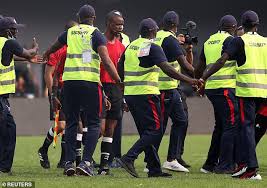
The madness began shortly after the 85th minute of a match that Mali led 1-0, and that should have lasted 90 minutes plus stoppage time. Zambian referee Janny Sikazwe - who had previously been suspended on suspicion of corruption - blew his whistle, raised his arms into the air and seemingly began to walk off the field. Tunisian players and coaches were initially perplexed, then furious. Within a minute, the error was corrected, and the match resumed. Pretty soon, though, it got stranger. Thirty seconds later, Sikazwe issued a red card to Mali's El Bilal Touré. Three minutes after that, with 89:43 on the clock, Sikazwe whistled for full time again. This time, the Tunisian protests were immediate. Coaches spilled out onto the field, to scream at the fourth official, then to run toward Sikazwe. They pointed at their watches. They grabbed him by the arm to try to make their point. Sikazwe eventually had to be escorted off the field by uniformed security guards, who surrounded him and his fellow referees and held back members of Tunisia's staff.
Their argument was not just that the match should have lasted through the 90-minute mark, but that it should have lasted well beyond 90 minutes. Early in the second half, Sikazwe awarded a penalty to Mali, which Ibrahima Kone converted for the only goal of the game. Later in the half, after a lengthy video review, he awarded a penalty to Tunisia, which Mali goalkeeper Ibrahim Mounkoro saved. Those stoppages, plus a cooling break, substitutions, the red card and the first mystifying full-time whistle, should have led to at least three minutes of added time, if not much more. Despite the protests, postgame routines went on as usual. Mounkoro accepted his man of the match award. Magassouba began speaking to the media. That's when, with beads of sweat running down his forehead, he was told that he and his players had to return to the pitch. "The players were more than willing," he said at a second news conference later. "Unfortunately, our opponents didn't want to come out." Tunisian players never reappeared. Kebaier later noted that many had already begun their post-match ice baths. Mali waited for them for several minutes, then the game was once again called off.
It's unclear if the result will be ruled a 1-0 Mali win, as it was when players initially left the field, or a forfeit. Tunisia could also file an official protest, and the game could be restarted or replayed at a later date. It's also unclear whether any action will be taken against Sikazwe, the referee CAF, the African football governing body, disciplined him after multiple controversial decisions in an African Champions League match in 2018. With a hearing pending, Sikazwe was provisionally suspended, but the ban was lifted in 2019. Previously, Sikazwe was regarded as a respected referee. He officiated two games at the 2018 FIFA World Cup. He had also attended previous editions of the Africa Cup of Nations, including the 2017 final, and the FIFA Club World Cup final in 2016.

Source: Yahoo

Inside UEFA’s VAR Remote Centre

The video assistant referee (VAR) has been a UEFA Champions League fixture since 2019, but this season, the process has been tweaked to operate remotely from UEFA HQ in Nyon, Switzerland, rather than at match venues across Europe. The new process was introduced for Euro 2020, driven by the pandemic-fuelled need to reduce numbers at each venue, with 22 video match officials sharing tournament duties. However, it proved so successful that it has been retained and is now used for all UEFA knock-out stage club competitions where possible (some venues don’t have the necessary fibre optics to make it work). Here, we take a look inside the VAR Remote Centre and experience a night at the controls with Marco Fritz, a German official who has been an international referee since 2012.
The VAR Remote Centre setup
Inside the room, located at UEFA HQ on the shores of Lake Geneva, there are six VAR stations, divided by partition screens, with two more stations in a separate space in the building. The main VAR is the leader of the team and the main point of contact with the on-field referee, with the task of focusing on incidents. The VAR is accompanied by an assistant video assistant referee (AVAR), concentrating on following the match, with the team accompanied by three operators, as well as a VAR support assistant who acts in a coordination capacity. The replay operator, trained in Hawk-Eye, has access to all the cameras in any given stadium, which are connected via a dedicated fibre link that ensures no more than a 50-millisecond delay to the pictures. On a busy match night, all manner of European languages fill the air, and as the games get underway, it’s fascinating to observe proceedings as officials communicate with their in-stadium colleagues.
The VAR: a match with Marco Fritz
Marco Fritz is the video assistant referee (VAR) for tonight’s Champions League matchday five game between Villarreal and Manchester United, joined in the room by an AVAR and two replay operators. The lights have gone down; ten minutes until show time. Fritz is on stage before curtain-up, pacing a little. Now he sits behind a desk and is shifting slightly in his chair; his fingers are tapping out a gentle rhythm on the desktop. It’s not nerves we’re witnessing, though. This is adrenalin. He’s ready to perform. Five minutes to go and headphones are on. One minute to go and the 44-year-old presses the large red button in front of him that allows him to talk to on-field referee Felix Brych, for one last audio check. And it’s a good thing he does – because Brych can’t hear him. Fritz calls over Alessandro Arduino, VAR project coordinator. Arduino has already been busy tonight: snow in Ukraine has necessitated red lines on the pitch and an orange ball for tonight’s game between Dynamo Kyiv and Bayern München; that, in turn, has meant recalibrating the VAR tech to recognise these two new colours. Now he’s back on the phone to resolve the lack of sound at the Estadio de la Cerámica; Brych is going to need a new headset. There’s no panic in the room, but there is palpable tension. The clock is ticking… The TV pictures show that Brych has reappeared. Are we back in business? Fritz is back on the red button, a bright red border appearing around his screen to signify that he’s opened communication. "Eins, zwei, drei…" A pause. Furrowed brows. Then: "Perfekt!" Good to go. "It’s not what you need but we know it can happen," Fritz says afterwards of the rare tech teaser. "You have to stay calm because the match is about to start. We have to be ready." With the match kicked off, he’s watching a live feed from the stadium’s main camera and can hear everything the referee and his assistants are saying in his headphones. Fritz also thinks it’s important for VARs to support their colleagues on the pitch. "If I can give confidence to the referee, it feels good for them," he says. "Not 500 times during the match and not for every decision, but every 20 minutes, why not?" It benefits him too. "Because I’m not in the stadium – I’m here – but I want to feel part of the team." If anything happens and Fritz wants to take another look, he’s got another screen lower down that has a three-second delay and provides four different camera angles. He’ll let the AVAR know that he’s checking something out (as the AVAR needs to watch for any further incidents, should the game still be in full flow) and then either returns to watching the game in real time or investigates further. If the latter, he’ll asks the replay operator to give him what he needs: different angle, pause, slow motion, zoom in, normal speed, multiple repeats – take your pick. He also lets the on-field official know what’s going on: "Right decision, well done, carry on"; "Delay, we’re still checking something." If it’s deemed that intervention is necessary, the VAR will either communicate that to the referee to implement the necessary decision or ask him to head for the pitch-side monitor, depending on the gravity of the situation. Now the ref can tell the replay operator what he wants to see and make the final decision himself. At half-time in the game, Fritz exits. "I go outside, where there’s no one, and just walk," he says. "I don’t want to speak to anyone, not even my AVAR. I just want three minutes to clear my head, then start again." Which he duly does, with no major incidents to deal with in the second half. Does that mean he’ll sleep well tonight? "No! I always have a lot of things on my mind. It’s a good thing that today we had the early match, because I’ve got time to relax now."
UEFA Referees Committee chairman, and former international referee, Roberto Rosetti: "In my time, every match was life or death. My last-minute speech with my colleagues before a game would be, ‘We must see everything.’ There was no possibility to watch again. Everyone else could, but not us. This was the paradox. [Now], it’s better because we can use a pool of VARs, the best in Europe. Quality is the priority. We had an excellent EURO but now the target is to try and maintain the same level. Perfect football doesn’t exist, it’s impossible. In this job, there is always room for improvement. We’re never satisfied."

Source: UEFA