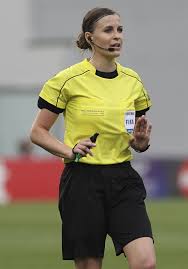
FIFA U-17 Women’s World Cup 2018 – Semi-finals

28 November 2018

Mexico – Canada
Referee: Anastasia Pustovoitova (RUS, photo)
Assistant Referee 1: Ekaterina Kurochkina (RUS)
Assistant Referee 2: Maria Sukenikova (SVK)
Fourth Official: Sandra Braz (POR)
Reserve AR: Mariana Almeida (ARG)

New Zealand – Spain
Referee: Yoshimi Yamashita (JPN)
Assistant Referee 1: Naomi Teshirogi (JPN)
Assistant Referee 2: Makoto Bozono (JPN)
Fourth Official: Laura Fortunato (ARG)
Reserve AR: Mary Blanco (COL)

UEFA Champions League – Group Stage (Matchday 5)

27 November 2018

AS Roma – Real Madrid
Referee: Clément Turpin (FRA, photo)
Assistant Referee 1: Nicolas Danos (FRA)
Assistant Referee 2: Cyril Gringore (FRA)
Fourth Official: Hicham Zakrani (FRA)
Additional AR 1: Ruddy Buquet (FRA)
Additional AR 2: Nicolas Rainville (FRA)
Referee Observer: William Young (SCO)

AEK Athens – AFC Ajax
Referee: Michael Oliver (ENG)
Assistant Referee 1: Stuart Burt (ENG)
Assistant Referee 2: Simon Bennett (ENG)
Fourth Official: Stephen Child (ENG)
Additional AR 1: Paul Tierney (ENG)
Additional AR 2: Andre Marriner (ENG)
Referee Observer: Haim Jakov (ISR)

CSKA Moskva – Viktoria Plzeň
Referee: Danny Makkelie (NED)
Assistant Referee 1: Mario Diks (NED)
Assistant Referee 2: Hessel Steegstra (NED)
Fourth Official: Rob van de Ven (NED)
Additional AR 1: Kevin Blom (NED)
Additional AR 2: Jochem Kamphuis (NED)
Referee Observer: Karen Nalbandyan (ARM)

Bayern München – SL Benfica
Referee: Daniele Orsato (ITA)
Assistant Referee 1: Lorenzo Manganelli (ITA)
Assistant Referee 2: Fabiano Preti (ITA)
Fourth Official: Alessandro Costanzo (ITA)
Additional AR 1: Paolo Mazzoleni (ITA)
Additional AR 2: Marco Guida (ITA)
Referee Observer: Manuel Díaz Vega (ESP)

TSG Hoffenheim – Shakhtar Donetsk
Referee: Ivan Kružliak (SVK)
Assistant Referee 1: Tomáš Somoláni (SVK)
Assistant Referee 2: Branislav Hancko (SVK)
Fourth Official: Tomáš Mókoš (SVK)
Additional AR 1: Peter Kráľovič (SVK)
Additional AR 2: Filip Glova (SVK)
Referee Observer: Marc Batta (FRA)

Olympique Lyonnais – Manchester City
Referee: Gianluca Rocchi (ITA)
Assistant Referee 1: Elenito Di Liberatore (ITA)
Assistant Referee 2: Mauro Tonolini (ITA)
Fourth Official: Matteo Passeri (ITA)
Additional AR 1: Luca Banti (ITA)
Additional AR 2: Daniele Doveri (ITA)
Referee Observer: Oğuz Sarvan (TUR)

Manchester United – Young Boys
Referee: Felix Brych (GER)
Assistant Referee 1: Mark Borsch (GER)
Assistant Referee 2: Stefan Lupp (GER)
Fourth Official: Markus Häcker (GER)
Additional AR 1: Bastian Dankert (GER)
Additional AR 2: Marco Fritz (GER)
Referee Observer: Paulius Malžinskas (LTU)

Juventus – Valencia
Referee: William Collum (SCO)
Assistant Referee 1: David McGeachie (SCO)
Assistant Referee 2: Graeme Stewart (SCO)
Fourth Official: Francis Connor (SCO)
Additional AR 1: Andrew Dallas (SCO)
Additional AR 2: Nicolas Walsh (SCO)
Referee Observer: Uno Tutk (EST)

28 November 2018
Atlético de Madrid – AS Monaco
Referee: Mattias Gestranius (FIN)
Assistant Referee 1: Jan-Peter Aravirta (FIN)
Assistant Referee 2: Mikko Alakare (FIN)
Fourth Official: Jukka Honkanen (FIN)
Additional AR 1: Antti Munukka (FIN)
Additional AR 2: Dennis Antamo (FIN)
Referee Observer: Jaap Uilenberg (NED)

Lokomotiv Moskva – Galatasaray
Referee: Antonio Mateu Lahoz (ESP)
Assistant Referee 1: Pau Cebrián Devís (ESP)
Assistant Referee 2: Roberto Díaz Pérez (ESP)
Fourth Official: Teodoro Sobrino Magán (ESP)
Additional AR 1: Xavier Estrada Fernández (ESP)
Additional AR 2: Alejandro Hernández Hernández (ESP)
Referee Observer: Levan Paniashvili (GEO)

Borussia Dortmund – Club Brugge
Referee: Gediminas Mažeika (LTU)
Assistant Referee 1: Vytautas Šimkus (LTU)
Assistant Referee 2: Vytenis Kazlauskas (LTU)
Fourth Official: Dovydas Sužiedėlis (LTU)
Additional AR 1: Donatas Rumšas (LTU)
Additional AR 2: Manfredas Lukjančukas (LTU)
Referee Observer: Luciano Luci (ITA)

PSV Eindhoven – FC Barcelona
Referee: Pavel Královec (CZE)
Assistant Referee 1: Ivo Nádvorník (CZE)
Assistant Referee 2: Kamil Hájek (CZE)
Fourth Official: Jakub Hrabovský (CZE)
Additional AR 1: Miroslav Zelinka (CZE)
Additional AR 2: Karel Hrubeš (CZE)
Referee Observer: Domenico Messina (ITA)

Tottenham Hotspur – Internazionale Milano
Referee: Cüneyt Çakır (TUR)
Assistant Referee 1: Bahattin Duran (TUR)
Assistant Referee 2: Tarık Ongun (TUR)
Fourth Official: Mustafa Eyisoy (TUR)
Additional AR 1: Hüseyin Göçek (TUR)
Additional AR 2: Barış Şimşek (TUR)
Referee Observer: Gylfi Orrason (ISL)

Paris Saint Germain – Liverpool FC
Referee: Szymon Marciniak (POL)
Assistant Referee 1: Paweł Sokolnicki (POL)
Assistant Referee 2: Tomasz Listkiewicz (POL)
Fourth Official: Radosław Siejka (POL)
Additional AR 1: Paweł Raczkowski (POL)
Additional AR 2: Tomasz Musiał (POL)
Referee Observer: Emil Božinovski (MKD)

SSC Napoli – Crvena Zvezda
Referee: Jesús Gil Manzano (ESP)
Assistant Referee 1: Ángel Nevado Rodríguez (ESP)
Assistant Referee 2: Diego Barbero Sevilla (ESP)
Fourth Official: Íñigo Prieto López (ESP)
Additional AR 1: Juan Martínez Munuera (ESP)
Additional AR 2: Ricardo de Burgos Bengoetxea (ESP)
Referee Observer: Michael Riley (ENG)

FC Porto – FC Schalke
Referee: Ovidiu Hațegan (ROU)
Assistant Referee 1: Octavian Șovre (ROU)
Assistant Referee 2: Sebastian Gheorghe (ROU)
Fourth Official: Radu Ghinguleac (ROU)
Additional AR 1: Radu Petrescu (ROU)
Additional AR 2: Sebastian Colțescu (ROU)
Referee Observer: Leslie Irvine (NIR)

Williams: “Perfection does not exist”

The problem with chasing perfection is that it doesn’t exist. That’s what I feel like we’re doing with Video Assistant Referees in football right now. VAR was introduced because the football community weren’t willing to trust referees or accept mistakes anymore. The new technology was supposed to make everything clear-cut. It was supposed to stop the howlers. Well, when you look at the media scrutiny of VAR since it was introduced, we seem to be ‘debating’ refereeing decisions more than ever before. Don’t get me wrong, I’m not against the use of technology, but it seems that we haven’t fixed a single thing. In fact, even when the right call has been made by VAR – as we saw with the Wanderers’ disallowed goal in the Sydney Derby – people still aren’t happy. I heard people argue that the technology shouldn’t have been used or that it wasn’t a foul or that Zullo ‘wouldn’t have got there anyway’. At the end of the day, the officials made a ruling. Michael was impeded by Jaushua Sotirio who was coming back from an offside position, and that stopped him defending the cross that led to Bonevacia’s goal. The officials were right to correct it. The FFA have since come out and said they want to set a higher threshold for when VAR can be used. They don’t want ‘nitpicking’. Now we’re trying to find a middle ground between assisting referees and interfering with the game, and everyone will have a different opinion on where that line is. What the Sydney Derby incident does tell me is that VAR doesn’t have an inherent technical flaw. The outrage was over a refusal to accept an interpretation of the Laws of the Game by a team of referees using the technology. In that case, the powers that be can tweak VAR as much as they want. It seems refereeing decisions will be argued about in coffee shops forever. And for me, the answer is simple. It’s something that has been lacking from Australian football for quite some time. Respect.
This isn’t democracy
People talk about refereeing decisions as if there is a debate to be had. We need to get real about one thing here: refereeing isn’t democratic. I don’t know whether it’s a part of our Aussie culture that goes back to the colonial days or what, but we struggle to show respect for people in authority. It doesn’t matter if we’re talking about a police officer, or in my case a qualified teacher and referee. Respect just isn’t there as a given. In football, a team of officials have been given a job after a stringent selection process, to go out there and make the tough calls. And they’ve been trained to do a better job at that than anyone else, under incredible pressure. That’s where the frustration lies for me, because I loved the challenge of honing my craft. I’m proud of my profession. With my friends Mathew Cream and Hakan Anaz, I travelled to 46 different countries refereeing tournaments: World Cup qualifiers, international friendlies and even a J-League derby between Urawa and Kashima at the Saitama Stadium during my exchange in Japan. When it comes to respect for referees, I can tell you that Australia is worse than many of those countries I have visited. I remember one incident from the 2014 World Cup in Brasil that illustrates this perfectly. I had to make a really tough call in my second match at the tournament, which was between Belgium and South Korea. It was 0-0 right before half-time when I saw one of the Belgian guys, Steven Defour, stomp on the leg of a Korean player. I knew at that moment that no one in the stadium – players, coaches or spectators – expected a red card. Still, I knew that the player must be sent off. The tough, but correct call, needed to be made. The tackle could have broken the Korean bloke’s leg and the slow-motion replays after the game would have showed that. I knew that if I didn’t act, my boss would be booking me a ticket home the next day. So, I trusted my gut. I told my team what I was going to do and they didn’t try to talk me down, so I walked over and issued a red card. Everyone in the stadium was stunned and I remember Kevin Mirallas and Marouane Fellaini coming over to ask what happened. But you know what? When I told them Steven had stomped on the Korean player’s leg and could have broken it, they just said, ‘OK, fair enough.’ I thought, ‘If I’d made that same decision in the A-League, the players would have gone absolutely berko and the fans would have been cursing me’. Even worse, I would have been brutally castigated in the media. At the World Cup, I was congratulated for making the right decision. My team and I went on to be appointed for a match in the round of 16 – the first Aussies at a men’s World Cup to be appointed past the group stage. Then I was back again in the quarter-finals as a Fourth Official for the match between Argentina and Belgium. There was an understanding, acceptance and professionalism around that incident that is often absent in Australia. I’ve seen our national teams and club sides struggle with this when they compete on the world stage and a decision goes against them. If you lose your head over a decision from the referee, mentally you’ve lost the game. For success at the highest level, we need to change. We need to rediscover the resilience many of our old national teams were famous for.
The cost of a big call
There are two other moments that stand out in my memory. The first is from a mid-week FFA Cup match where I had to send a defender from one team off for kicking an attacking player in the chest. I knew that it was 100 per cent the right call to make but after the match no one backed me up. The commentators had plenty of scathing things to say and they got the coach to say what they wanted – that I’d ruined the match and cost his team. It all blew up. I was supposed to be on the Melbourne Derby that weekend but there was such a media outcry that I was taken off the match. A different referee was appointed in my place. I’d been excited for the derby for ages as well, because those big games are the ones you look forward to, just the same as the players and fans do. It’s a huge buzz refereeing in front of big crowds like that. You can imagine how disappointing it was to miss out. It wasn’t long after that I flew to Kuala Lumpur for a training seminar at the AFC headquarters. As I was walking in, FIFA’s main instructor took me aside. He said he had one of my clips in his presentation. As you can imagine, I was more than a bit nervous to hear that. He said, ‘Yeah, the red card in the Cup. We’re using that as an example for other referees of what they should do.’ The way everything had panned out was laughable. In Australia, many people had hung me out to dry for that decision but here was FIFA, using it as an example of good refereeing. Talk about a lack of understanding and respect! The second incident was at the 2015 Asian Cup in Australia. I was appointed referee for a quarter-final in Canberra between two huge rivals – Iran and Iraq. We had known this was a potential match-up since the draw had been released, and that my team may be a chance of being appointed. With that in mind, I worked with my two assistant referees, Matthew Cream and Paul Cetrangolo, on our analysis before the tournament so we could be fully prepared. I was excited about the prospect of being tested in such a big match, in my hometown, in front of my family and friends. It was a match that certainly lived up to the hype! With Iran up 1-0 just before half-time, I had to caution one of their players for simulation in the penalty area. He was attempting to deceive me into awarding a penalty. I ran over and told him there was no foul and that he needed to get up. He refused to follow my requests and stayed down, insisting there had been a foul. After calmly asking a few times, I said again that there was no foul and that he needed to get on with the game or face a caution. He continued to delay, so he received a yellow card as he sat on the ground with his number obscured. As I ran back to halfway, the Iraqi players pointed out that it was his second yellow. I checked and saw it was indeed a player that had already been booked. The Laws of the Game are clear, so I showed the red card and he was sent off. In such a big match, the delay between the yellow and the red card caused the ‘controversy’. It wasn’t ideal, but it was the right thing to do for that player’s behaviour. I had to act. The match got even crazier after that. It was 1-1 after regular time, then 3-3 after extra time before Iraq won on penalties. It was one of the most intense games I’d ever been involved with as a referee and walking off the field I was confident in all the decisions my team had made. But once again, the Australian media castigated me and the way they attacked me framed how the match was reported on internationally by the world media. Thankfully, I’ve never been on social media. The Iranian fans went crazy and flooded the Facebook page of some other unsuspecting Ben Williams. I didn’t read any of the media or comments after the match, but my wife did. She saw all the death threats being made against us and our baby. As you can imagine, my wife didn’t feel safe staying in our own home that night. An Australian Federal Police officer had been assigned to each team of referees for the whole tournament. The officer looking after us said my family would be protected, but for me the line had already been crossed. Members of the Aussie media had fuelled the hatred, in turn jeopardizing the safety of my family. All over a decision that had been correct, albeit delayed. The Aussie commentators had made out like I was the worst person to ever take up the whistle. On the other hand, the AFC stood by my decision and backed me up, and when my performance was assessed, I received extremely high marks. In fact, the match had so many challenging moments that it became an example used by referee coaches throughout Asia. Unfortunately, in my career there were many other times where I felt misrepresented in the Australian media. In fact, it got to the point where I considered legal action for defamation because I have no doubt that there were refereeing appointments I missed out on because of what was said about me in the media and how I was portrayed. I see this as a problem for many officials. The greatest currency for a referee is credibility, and when that credibility is eroded by uninformed voices it diminishes a referee’s capacity to control a match and make the hard but fair calls. I know I was a referee that stuck to his guns and some people didn’t like that. If I’d not had any success outside of Australia maybe I could understand my critics saying ‘You know what, mate, you weren’t that good,’ but I won’t cop that, because I did achieve a lot internationally. With the help of my team, I managed to get into the top 10 referees in the world and was voted best in the AFC. I refereed at FIFA tournaments, the Olympics and even the Asian Champions League Final. I didn’t stop and think much about all that at the time. It’s only since my career ended that I’ve been able to sit back, reflect, and feel a great sense of pride at what I achieved. There’s one thing I never got the chance to do, though. I never got to referee an A-League Grand Final. That kind of says it all really. Mind you, I wouldn’t trade my experiences internationally for that A-League GF!
Why we need to change
The younger officials just starting out now are the people I feel really bad for in all this. All those young boys and girls who will give up their lives for football, to go out there and do what they love, with the dream of representing Australia on the international stage one day. As it stands, they won’t receive the gratitude or respect they deserve for the sacrifices they make for the game. All they’ll get is criticism and anger for the small number of mistakes that are inevitable for any referee finding their feet at the elite level. Referees are marked against decision-making KMIs and achieve percentiles high in the 90s. You could argue that is much higher than the players! Star strikers will sometimes shoot the ball over the bar from six yards out, or a goalkeeper will fail to make an easy save. Still, the media never seem to go after those players in the same way they do with referees. Why can’t we just accept that referees will get it correct far more often than they get it wrong? It’s a tall-poppy syndrome and it extends beyond how we treat officials. I’ve seen top Socceroos brought down in the same way when they’ve come back to play in the A-League. One error and they’re crucified for it. It’s sad because that makes other Socceroos start thinking, ‘Well, why would I come back to play in Australia and put myself through that?’ We’re only hurting ourselves in all this and that’s why Australian football needs to change. I think it all comes down to education. There would be more respect for referees if people were less ignorant of what we actually do. We don’t just ‘rock up’ on match day, see how we feel, and blow a whistle. Self-analysis. Coaching and peer mentoring. Video analysis of tactics, teams and players. Discussing decision-making with other elite officials and coaches around the world. These are just some of the things we do each and every week to stay at the top of our game. Refereeing is physically demanding as well and it’s our own money that we spend to make sure our bodies can keep pace with the quickest players in the world. Getting on the park each week takes massage, acupuncture, running technique coaches and advice from nutritionists. Mentally, you might even need sessions with a sports psychologist. There’s more to refereeing than meets the eye! In recent years, we’ve been trying to educate people more about the preparation required. At the 2014 World Cup, the legendary Brazilian footballer Zico loaned his football facility in Rio de Janeiro to FIFA for the referees to use as a training base. He understood that referees need support to perform at the highest level and wanted us to have the best. After we’d settled in, the Head of Referees put on an open training session for the media. More than 160 members of the media from all around the world came to watch and speak with us. They lapped it up, because it was all stuff they’d never seen before. We took that idea into the 2015 Asian Cup in Australia and hosted a similar day in Sydney. Media came from as far as Japan and the Middle East but no one from Australia, even though it was in our own backyard. It’s unfortunate, because our commentators and journalists are the ones who could have benefitted most, I think. It’s important because the public often hear the commentary and read what’s in the newspapers and take that information as gospel. But when it comes to the ‘expert commentary’ regarding referees, it is ill-informed and unbalanced. In my opinion, the Australian media’s relationship with domestic clubs is often too close. Many Aussie commentators are ex-players who may have been sent off by the referees they are now commentating on. With the platform they now have, it’s easy for them to voice their own opinions, or even ask players and coaches for headlines, to feed outrage. That outrage can suit coaches as well because it’s an opportunity to deflect pressure away from their team. It’s easier for them to blame a referee instead of having to answer for their team’s poor performance. I think our media let coaches off too easily by providing them with this out. In some other countries, football analysts see through these smoke-screens and hold teams to account for the betterment of the game.
The one thing I miss
In the two-and-a-half years before the 2014 World Cup, I spent 400 days overseas. It got to the point where I’d be at the airport getting ready to fly out again, and my daughter would be pleading, ‘Daddy please don’t go.’ It breaks your heart and changes your perspective on things, that’s for sure. From that point, chasing a football around the world became less important. I decided to give up refereeing in 2016 after 25 years in the profession. It was time for me to focus on my family. My wife knew me well before my football career really took off and she has supported me in achieving my dreams, even when we were going through some really tough times. We lost our first daughter just a couple of months before the Olympics in 2012, and my Dad passed away nine days after I got back from the 2014 World Cup. Life has so many highs and lows. My wife was my strength off the field. She and my family kept me grounded, supporting me through it all. Away from home, Matthew Cream and Hakan Anaz were the best teammates I could have hoped for. I’m endlessly grateful because they were always there for me. I’m not sharing this information to seek pity – just as a reminder that referees are human. We have strengths and weaknesses and we’re certainly not infallible. I made mistakes in my career, but I can tell you that I got it right far more than I got it wrong. I want the next generation to get the right support. I don’t want them to miss out on the same magnificent ride that I was blessed to experience. I want them to go on and surpass my achievements and for our country to be proud of them. Do I miss running out in front of 100,000 people? Bloody oath! But I don’t miss the negative press or the countless training hours. I don’t miss red-eye flights back from Perth, Japan or the Middle East and catching a taxi straight from the airport to work. I don’t miss flying out again the next day to referee an A-League game, again and again. I don’t miss suffering financially for taking leave from work, just to represent my country. I don’t miss the sacrifices and moments missed with family. What I do miss, is running out into a cauldron atmosphere with your best mates and getting an absolute box seat for some of the best football in the world. Nothing can replace that. Those memories, they will live with me forever.

Source: PlayersVoice

UEFA Youth League – Group Stage (Matchday 5)

27-28 November 2018

AS Roma – Real Madrid
Referee: Fedayi San (SUI, photo)
Assistant Referee 1: Jean-Yves Wicht (SUI)
Assistant Referee 2: Carmine Sangiovanni (SUI)
Fourth Official: Francesco Fourneau (ITA)
Referee Observer: Matteo Trefoloni (ITA)

CSKA Moskva – Viktoria Plzeň
Referee: Aleksandr Aliyev (KAZ)
Assistant Referee 1: Yevgeni Karlov (KAZ)
Assistant Referee 2: Anton Sysoyev (KAZ)
Fourth Official: Aleksandra Ponomareva (RUS)
Referee Observer: Nikolay Ivanov (RUS)

AEK Athens – AFC Ajax
Referee: Trustin Farrugia Cann (MLT)
Assistant Referee 1: Roberto Vella (MLT)
Assistant Referee 2: Christopher Francalanza (MLT)
Fourth Official: Aristotélis Diamandópoulos (GRE)
Referee Observer: Ioánnis Tsachilídis (GRE)

Manchester United – Young Boys
Referee: Robert Harvey (IRL)
Assistant Referee 1: Emmett Dynan (IRL)
Assistant Referee 2: Mark Gavin (IRL)
Fourth Official: Anthony Backhouse (ENG)
Referee Observer: Stephen Lodge (ENG)

TSG Hoffenheim – Shakhtar Donetsk
Referee: Christophe Pires (LUX)
Assistant Referee 1: Joaquim Gomes (LUX)
Assistant Referee 2: Tom Hansen (LUX)
Fourth Official: Robert Kempter (GER)
Referee Observer: Konrad Plautz (AUT)

Olympique Lyonnais – Manchester City
Referee: Mete Kalkavan (TUR)
Assistant Referee 1: Candaş Elbil (TUR)
Assistant Referee 2: Deniz Caner Özaral (TUR)
Fourth Official: Jérémie Pignard (FRA)
Referee Observer: Rusmir Mrković (BIH)

Bayern München – SL Benfica
Referee: Karim Abed (FRA)
Assistant Referee 1: Mehdi Rahmouni (FRA)
Assistant Referee 2: Mikaël Berchebru (FRA)
Fourth Official: Michael Bacher (GER)
Referee Observer: Jiří Ulrich (CZE)

Juventus – Valencia
Referee: Tihomir Pejin (CRO)
Assistant Referee 1: Marjan Tomas (CRO)
Assistant Referee 2: Kruno Šarić (CRO)
Fourth Official: Fabio Piscopo (ITA)
Referee Observer: Alfredo Trentalange (ITA)

Lokomotiv Moskva – Galatasaray
Referee: Danilo Grujić (SRB)
Assistant Referee 1: Goran Bogićević (SRB)
Assistant Referee 2: Milorad Jovanović (SRB)
Fourth Official: Yevgeniy Turbin (RUS)
Referee Observer: Aleksandr Gvardis (RUS)

Atlético de Madrid – AS Monaco
Referee: Stuart Attwell (ENG)
Assistant Referee 1: Edward Smart (ENG)
Assistant Referee 2: Daniel Robathan (ENG)
Fourth Official: Miguel Ortiz Arias (ESP)
Referee Observer: Manuel Mejuto González (ESP)

PSV Eindhoven – FC Barcelona
Referee: Donald Robertson (SCO)
Assistant Referee 1: Daniel McFarlane (SCO)
Assistant Referee 2: Calum Spence (SCO)
Fourth Official: Siemen Mulder (NED)
Referee Observer: Marinus Koopman (NED)

Tottenham Hotspur – Internazionale Milano
Referee: Alex Troleis (FRO)
Assistant Referee 1: Johnleif Gerðisá (FRO)
Assistant Referee 2: Jón Johannesen (FRO)
Fourth Official: John Brooks (ENG)
Referee Observer: Are Habicht (EST)

SSC Napoli – Crvena Zvezda
Referee: Sándor Andó-Szabó (HUN)
Assistant Referee 1: Balázs Szalai (HUN)
Assistant Referee 2: Gergő Vígh-Tarsonyi (HUN)
Fourth Official: Luca Massimi (ITA)
Referee Observer: Plarent Kotherja (ALB)

Borussia Dortmund – Club Brugge
Referee: Boris Marhefka (SVK)
Assistant Referee 1: Tomáš Vorel (SVK)
Assistant Referee 2: Milan Štrbo (SVK)
Fourth Official: Johann Pfeifer (GER)
Referee Observer: Kaj Natri (FIN)

FC Porto – FC Schalke
Referee: Eldorjan Hamiti (ALB)
Assistant Referee 1: Egin Doda (ALB)
Assistant Referee 2: Ilir Tartaraj (ALB)
Fourth Official: João Gonçalves (POR)
Referee Observer: António Almeida (POR)

Paris Saint Germain – Liverpool FC
Referee: Christian Dingert (GER)
Assistant Referee 1: Tobias Christ (GER)
Assistant Referee 2: Timo Gerach (GER)
Fourth Official: Bastien Dechepy (FRA)
Referee Observer: Robert Małek (POL)

UEFA Youth League – Domestic Champions Path (Second Round, Second Leg)

27-28 November 2018

GNK Dinamo – FC Astana
Referee: Pavel Orel (CZE, photo)
Assistant Referee 1: Radek Kotík (CZE)
Assistant Referee 2: Petr Caletka (CZE)
Fourth Official: Ivan Vučković (CRO)
Referee Observer: Dragutin Poljak (CRO)

Dynamo Kyiv – RSC Anderlecht
Referee: Dzianis Ščarbakoŭ (BLR)
Assistant Referee 1: Juryj Chomčanka (BLR)
Assistant Referee 2: Anton Husieŭ (BLR)
Fourth Official: Denys Shurman (UKR)
Referee Observer: Volodymyr Petrov (UKR)

FC Minsk – PAOK
Referee: Dejan Jakimovski (MKD)
Assistant Referee 1: Dejan Nedelkoski (MKD)
Assistant Referee 2: Daniel Vasilevski (MKD)
Fourth Official: Anton Lašuk (BLR)
Referee Observer: Alieh Čykun (BLR)

Hertha BSC – Qabala FK
Referee: Ferenc Karakó (HUN)
Assistant Referee 1: Tibor Csatári (HUN)
Assistant Referee 2: Norbert Bornemissza (HUN)
Fourth Official: Lasse Koslowski (GER)
Referee Observer: Edgar Steinborn (GER)

Chelsea – Elfsborg
Referee: Kristoffer Hagenes (NOR)
Assistant Referee 1: Anders Dale (NOR)
Assistant Referee 2: Runar Langseth (NOR)
Fourth Official: John Busby (ENG)
Referee Observer: John Ferry (NIR)

Montpellier Hérault – Altınordu
Referee: Urs Schnyder (SUI)
Assistant Referee 1: Jan Köbeli (SUI)
Assistant Referee 2: Jonas Erni (SUI)
Fourth Official: Arnaud Baert (FRA)
Referee Observer: Marcel Vanelshocht (BEL)

Maccabi Tel Aviv – Sigma Olomouc
Referee: Alper Ulusoy (TUR)
Assistant Referee 1: Gökmen Baltacı (TUR)
Assistant Referee 2: Bersan Duran (TUR)
Fourth Official: David Fuxman (ISR)
Referee Observer: Shmuel Shteif (ISR)

Hamilton Academical – FC Midtjylland
Referee: Bryn Markham-Jones (WAL)
Assistant Referee 1: Daniel Beckett (WAL)
Assistant Referee 2: Harry Hendricks (WAL)
Fourth Official: David Dickinson (SCO)
Referee Observer: Iain Robertson Brines (SCO)

FIFA U-17 Women’s World Cup 2018 – Quarter-finals

24 November 2018

Spain – Korea DPR
Referee: Katalin Kulcsar (HUN, photo)
Assistant Referee 1: Katalin Török (HUN)
Assistant Referee 2: Lucie Ratajova (CZE)
Fourth Official: Sandra Braz (POR)
Reserve AR: Oleksandra Ardasheva (UKR)

Japan – New Zealand
Referee: Ekaterina Koroleva (USA)
Assistant Referee 1: Felisha Mariscal (USA)
Assistant Referee 2: Deleana Quan (USA)
Fourth Official: Lucila Venegas (MEX)
Reserve AR: Stephanie Yee Sing (JAM)

25 November 2018
Ghana – Mexico
Referee: Maria Carvajal (CHI)
Assistant Referee 1: Leslie Vasquez (CHI)
Assistant Referee 2: Loreto Toloza (CHI)
Fourth Official: Laura Fortunato (ARG)
Reserve AR: Rocio Puente Pino (ESP)

Germany – Canada
Referee: Salima Mukansanga (RWA)
Assistant Referee 1: Fanta Kone (MLI)
Assistant Referee 2: Bielignin Some (BFA)
Fourth Official: Yoshimi Yamashita (JPN)
Reserve AR: Sarah Jones (NZL)

Updated list of referees for FIFA Club World Cup 2018

The FIFA Referees Committee has announced a number of changes to the list of match officials who will officiate at the FIFA Club World Cup UAE 2018, which takes place from 12-22 December 2018: 
- Bamlak Tessema (Ethiopia, photo) has been appointed as a referee representing the CAF region. He replaces Mehdi Abid Charef (Algeria).
- Zakhele Siwela (South Africa) and Waleed Ahmed (Sudan) have been appointed as assistant referees for the tournament. They replace Abdelhak Etchiali (Algeria) and Anouar Hmila (Tunisia).
All of the selected match officials will arrive in Abu Dhabi on 6 December 2018 to complete their final preparations before the first match kicks off. The FIFA Club World Cup UAE 2018 will be held in Abu Dhabi and Al Ain from 12 to 22 December 2018. The final will be played at the Zayed Sports City Stadium in Abu Dhabi on 22 December. (Source: FIFA)


AFC
Referee: Ryuji Sato (JPN, 1977)
Assistant Referee 1: Toru Sagara (JPN, 1976)
Assistant Referee 2: Hiroshi Yamauchi (JPN, 1979)

VAR: Abdulla Mohammed (UAE, 1978)

CAF
Referee: Bamlak Tessema (ETH, 1980, photo)
Assistant Referee 1: Zakhele Siwela (RSA, 1982)
Assistant Referee 2: Waleed Ahmed (SDN, 1974)

CONCACAF
Referee: Jair Marrufo (USA, 1977)
Assistant Referee 1: Frank Anderson (USA, 1975)
Assistant Referee 2: Corey Rockwell (USA, 1974)

VAR: Mark Geiger (USA, 1974)

CONMEBOL
Referee: Wilton Sampaio (BRA, 1981)
Assistant Referee 1: Rodrigo Figueiredo (BRA, 1983)
Assistant Referee 2: Bruno Boschilia (BRA, 1983)

VAR: Mauro Vigliano (ARG, 1975)

OFC
Referee: Matthew Conger (NZL, 1978)
Assistant Referee 1: Tevita Makasini (TGA, 1976)
Assistant Referee 2: Mark Rule (NZL, 1981)

UEFA
Referee: Gianluca Rocchi (ITA, 1973) 
Assistant Referee 1: Elenito Di Liberatore (ITA, 1973)
Assistant Referee 2: Mauro Tonolini (ITA, 1973)

VAR 1: Pawel Gil (POL, 1976)
VAR 2: Massimiliano Irrati (ITA, 1979)
VAR 3: Danny Makkelie (NED, 1983)

IFAB recommends fine-tuning Laws

The 133rd Annual Business Meeting of the International Football Association Board took place in Glasgow, Scotland, chaired by Ian Maxwell, Chief Executive of the Scottish FA. The event saw positive feedback received on the changes to the Laws of the Game for 2018/19 and an agreement to recommend additional changes to the Laws of the Game 2019/20 at the AGM in March 2019, including a change to the dropped ball procedure and goalkeepers only being required to have one foot on the goal-line when a penalty kick is taken.
The ABM is designed to evaluate proposals related to potential changes of the Laws of the Game and to make recommendations for The IFAB’s consideration at its next Annual General Meeting (AGM). Some of today’s discussions focused on the positive feedback received by The IFAB Advisory Panels that met earlier this month to discuss ongoing experiments in the following areas:
•substitutes having to leave the field of play at the nearest boundary line
•yellow and red cards for misconduct by team officials
•the ball not having to leave the penalty area at goal kicks
•defending team free-kicks taken inside the penalty area
The members at the ABM unanimously recommended that all these changes should be supported by the AGM in March for inclusion in the Laws of the Game 2019/20.
Additionally, based on experiences from competition trials, the alternative order of kicks during Kicks from the Penalty Mark (so-called ‘AB-BA’), the Board noted the absence of strong support, mainly because the procedure is complex, and agreed that it will no longer be a future option for competitions.
One of the most debated areas of the Laws of the Game is handball and this topic was discussed at length during the ABM, with an agreement being reached on the necessity for a more precise and detailed wording for the different types of handball offences. The ABM duly took note of football stakeholders’ expectations, so the most significant clarifications relate to ‘non-deliberate’ handball situations, where there is an unfair ‘outcome/benefit’ due to the ball making contact with a player’s hand/arm (e.g. a goal should not be allowed if the ball goes directly into the goal from a player’s hand/arm or if a player gains control/possession of the ball from contact with hand/arm and then scores or creates a goal-scoring opportunity).
Discussions also focused on the next steps to be taken regarding the Play fair! Initiative, including measures to address attacking players who cause disruption in the defensive ‘wall’, as well as a dropped ball being given if the ball hits the referee and a goal is scored, team possession changes or an attacking move is created.
The meeting concluded with an update on the current worldwide use of Video Assistant Referees (VARs), where FIFA’s Football Technology Innovation Department and FIFA Refereeing outlined the successful use of VARs at the 2018 FIFA World Cup Russia.
Members were also informed about the mandatory FIFA/IFAB VAR implementation Assistance and Approval Programme (IAAP) that all competitions wishing to use VARs must complete in order to receive the necessary approval to use the system in competitive matches.
The 133rd Annual General Meeting of The IFAB will be held in Scotland on 2 March 2019 and will ultimately decide which of today’s proposals and recommendations become part of the Laws of the Game as of 1 June 2019.

Source: IFAB

Referee Hategan comforted by Dutch defender Van Dijk

Virgil van Dijk took time to console bereaved referee Ovidiu Hategan following the Netherlands 2-2 draw with Germany on Monday. The Dutch captain scored a 90th-minute equaliser in Gelsenkirchen to ensure his side finished top of Group A1 and sealed their place in the UEFA Nations League Finals. However, instead of immediately celebrating with his team-mates at full-time, Van Dijk went to speak with Romanian official Hategan, who can be seen wiping away tears as the Liverpool defender embraced him and offered words of encouragement following a family bereavement.
"The ref had just lost his mother," Van Dijk told Fox Sports after the match. "He broke down with tears in his eyes. I told him to stay strong and that he had refereed well. It's a small thing, but maybe it helps him". The gesture has impressed journalists and fans. “Referee Ovidiu Hategan recently lost his mother. Right after the FT whistle Virgil van Dijk went towards him to comfort him, while crying. This is beautiful,” AFC Ajax wrote. 
Ovidiu Hategan’s mother died on Monday in hospital, after a long sufferance. The 38-year old referee learned about the news at half-time, informed by the family, as he had previously agreed, to be constantly informed about her health. (Source: SkySports / Romania Journal)

Top African referee Sikazwe suspended over corruption allegations

CAF have provisionally suspended Zambian referee Janny Sikazwe on suspicion of corruption following the way he handled the CAF Champions League match that Esperance won 4-2 in Rades. It is not yet clear if Sikazwe has filed an appeal with the CAF Appeals Board.
“The chairman of the CAF Disciplinary Board decided that there is good ground to hold a hearing regarding allegations of corruption made against Mr. Janny Sikazwe”, reads the ruling of the Disciplinary Board. “Janny Sikazwe is provisionally suspended from all football activities related to CAF pending a hearing before the Disciplinary Board”.
Sikazwe, who refereed at the 2018 FIFA World Cup, awarded a controversial penalty kick which led to Esperance’s first goal after adjudging Algerian forward Mohamed Belaili to have been fouled by Agosto defender Jose Macaia. In the second half, Agosto thought they had buried the contest but Bobo Ungenda’s goal was disallowed after Esperance goalkeeper Rami Jridi was ruled to have been pushed by Mingo Bille in the process. The Tunisians’ winning goal came as scorer Anice Badri appeared to have had infringed on an Agosto defender attempting to clear danger.

Source: SportingNews