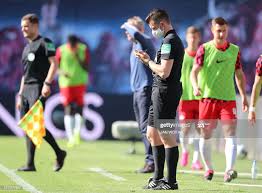
Clattenburg admitted Real's offside goal in 2016 UCL final

Atletico Madrid have tweeted a response after referee Mark Clattenburg admitted rivals Real Madrid's crucial opener in the 2016 Champions League final should have been ruled out for offside. The club tweeted a "thinking face" emoji alongside images of various Spanish newspaper reports detailing the admission on Thursday. Clattenburg's comments have made headlines in Spain, where Atletico fans have long felt that Sergio Ramos' 15th minute goal - in a game that Real Madrid went on to win 5-3 on penalties - should not have stood. 
"Real Madrid went 1-0 up in the first half, but the goal was slightly offside and we realized at half-time - it was a hard call and my assistant missed it," the British referee told the Daily Mail. "I gave Atletico a penalty early in the second half. Pepe was furious and said to me in perfect English: 'Never a penalty, Mark.' I said to him: 'Your first goal shouldn't have stood.' It shut him up. People might think that sounds odd, because two wrongs don't make a right and referees don't think like that, but players do," Clattenburg went on. "I knew by saying that to him it would make him more accepting of the situation. He was a wind-up merchant and not fun to referee one bit, you had to be on your guard constantly." 

Source: ESPN

MLS referees would make "sensible" adjustments

With the growing likelihood that any 2020 MLS season return would occur without fans in the stands, Professional Referees Organization general manager Howard Webb anticipates a period where his colleagues adjust to that reality. After all, they’re accustomed to making game-altering decisions with tens of thousands of raucous fans in attendance each weekend. That'll impact referees just as it would players, and Webb said earlier via conference call that he’s hoping English referee Anthony Taylor could be a resource. Before Covid-19 suspended soccer in Europe, Taylor oversaw a closed-doors Champions League Round of 16 encounter between Paris Saint-Germain and Borussia Dortmund at Parc des Princes. “One of the things we've been looking to do in the coming weeks is maybe bring in some officials who have had experience of refereeing games without fans, fairly recent experience, to share with our group what that felt like,” Webb said. “What was it like? What do you expect, and how was it different? And we're looking at doing that with a few of the guest speakers that are going to share that experience.” There's also the need for referees to be at match fitness, since they’ll need to keep pace with players at a full sprint. In preparation, Webb said, he’d hope that MLS referees could officiate scrimmages after last doing so March 8 when LAFC hosted the Philadelphia Union.
Webb also anticipates changes in game-day routines, such as increasing the number of substitutes and doing away with pre-game handshakes. “You know, these are sensible things, aren’t they, when we're coming into a phase of the game where the cadence of games could be higher than normal,” Webb said. “ These things make sense and no decisions have been taken yet with what will happen in MLS, whether they’ll use additional subs up to the maximum of five, which (the International Football Association Board) says we can do. But I'm expecting that that's quite likely and then seems to be a sensible introduction.” Whatever environment referees enter, Webb expects safety and sensibility to prevail. He cited an anecdote from the K-League in South Korea as how it all could look. “I saw a video a few days ago of a Korean game where the referee was asked by a player to pick him up by the hand and the referee said, ‘Sorry, I can't pick you up,’” Webb said. “It was quite interesting to see how that was on the mind of that particular official. And again, we'll be reminding our referees of the need to not create unnecessary contact when it doesn't need to happen and to be sensible and to maintain their personal space. But that’s pretty standard officiating anyway, not to get into a player’s face, for example.” 
He said officials are preparing for everything — including working out of a central hub if Major League Soccer goes ahead with a reported plan to bring all the teams to a location like the Orlando area when the league returns to action without spectators. Webb acknowledged that not all of his officials may be able to commit the time needed to move to a hub for a block of games. “We’re hoping as many as possible will,” he said. Officials are as keen as the players to get back to action, Webb said. “I’ve had no pushback in terms of the safety issues,” he added. “I think our workforce is fully confident that the environment will be a safe one and that testing will be available and that the necessary PPE (personal protection equipment) will be available.” Webb said officials will have to be tested for Covid-19, like the players. “It’s not possible to socially distance our officials when they’re doing their job,” he said. “And of course, the games will be meaningful when they get started again and they’ll be officiated in the normal way.” PRO officials are in contact with MLS twice a week as the league works on getting back on the field. On the plus side, Webb said his officials are well equipped to work remotely during the pandemic, given they do it during the season due to their geographical spread. The officials are taking part in virtual “training camps” and fitness regimens. MLS referees are full-time and are still getting paid although they are not receiving match fees. Assistant referees and video assistant referees are not full-time, although they get a retainer at the start of the season. They too are missing game fees. Webb said PRO staff like himself have taken a pay cut during the pandemic. 

Source: MLS

DFB: VAR intervention was "not appropriate"

The last-second penalty kick against VfB Stuttgart heated the minds of the Swabs and led to another explanation from the DFB. VfB Stuttgart is upset about the referees after their unsuccessful restart and fundamentally questions the video evidence. But what actually happened? Quite simply: although the game continued after a corner kick in added time, the game was suddenly interrupted for an on-field review, with one and a half minutes of communication between referee Sascha Stegemann and VAR Robert Kampka. 
The DFB classified the decision as "technically correct". However, the sporting management of the elite referees also admitted that there was room for discretion for Stegemann. After all, the handball was clearly not recognizable. To summarize briefly: The intervention of the VAR was not appropriate, but the process afterwards proceeded within the framework of the rules. "The arm position of the Stuttgart defender above the shoulder - the hand is stretched forward halfway and lies on the arm of the Wiesbaden striker - is to be classified as unnatural and a penalty kick is technically in order, whereby when considering the entire sequence of movements of the player cannot classify the process as being very clear. The process is therefore a scene which, in its evaluation, represents a discretionary area for the referee on the field. On the question of the need for intervention by the video assistant, we consider the on-field review recommendation made by the video assistant, against the background of the discretionary scope and therefore not a clear and obvious error by the referee, as inappropriate. This would also apply if the referee had only seen the process to a limited extent. Since it was a very detailed process, a detailed analysis by the video assistant was necessary in order to be able to illustrate the handball. This proof could be provided by a high-resolution camera. In the on-field review, it was difficult for the referee to recognize the handball, so the referee asked the video assistant several times about this proof to be absolutely certain. After confirmation by the video assistant, the referee then requested various camera angles in order to evaluate the question of 'punishable or not punishable?' As in the present case, only the referee can make this evaluation. In the end, the referee judged this process to be punishable in his discretion and, according to the rules, he correctly awarded a penalty kick." 

Source: Kicker

New competition rules in CONMEBOL

The CONMEBOL Council approved adjustments to the regulations applicable to the 2020 Copa Libertadores and Copa Sudamericana. The modifications require that each club and other participants to adapt to the situation generated by the Covid-19 pandemic.
· Prohibition for players and officials to spit and blow their nose before, during and after the game in the competition area (playing field, benches). 
· Prohibition for players and officials to kiss the ball before, during and after the game. 
· Mandatory for players and officials to submit to temperature control before the game. 
· Mandatory for players and officials to use individual bottles of water or isotonic drinks. 
· Prohibition on exchanging/giving away shirts or any other part of the clothing with opponents or teammates from the same team or any other person. 
· Mandatory use of a mask for players and officials in the technical areas. 
· The exchange of pennants or presents between both captains is prohibited. 
· If a post-match interview and/or press conference is allowed, a mask or face shield must be used. 

Source: CONMEBOL

Referees need 21 days of training before returning to competitions

The fitness instructor of the CONMEBOL Referees Committee, Juan Carlos Albarracin, affirms that professional football referees need at least 21 days of training to regain form before facing the resumption of tournaments, since the physical demands are equal to that of footballers in official competitions.
"They will require a pre-season to avoid injuries, such as contractures and tears during the games. It will be essential for the referees to carry out a pre-season of up to 21 days as soon as the group activities are resumed to regain mobility, resistance work, because all this will be very fundamental. At home they have been able to carry out training to develop strength, functional work, but not everyone has equipment to be able to perform in the best way as everyone would like." 

Source: EFE

Bundesliga: What happens if the referee is infected?

"Both the special hygiene regulations and the corona tests, as well as refereeing in front of empty stands require special preparation", said Lutz-Michael Fröhlich in an interview with ntv.de. The sporting director of the elite referees and his team have communicated a lot in video conferences with the 26 first division and 22 second division referees, discussed controversial game scenes, discussed training performances and discussed possible scenarios for when and how the season should continue could be. Now that it is clear when the ball will roll again, the referees will also take action. So far, however, they have not been tested for the Sars-CoV-2 virus "because they do not go into team training like the players," explains Fröhlich. "They get tested when they get their first assignment." This means that the referees, assistants and fourth officials will be tested for the first time a few days before their return and again the day before the game. As the season progresses, there will be a test the day before the match. The result must be available by 10 a.m. on the match day, as the DFL concept provides. "The hygiene requirements are top priority, as we also have a role model function," said Fröhlich. The referees are behaving “in the stadium, at home and during training according to the instructions of the DFL, which were also given to the clubs".
What happens if the referee tests positive? The tests the day before a match are "carried out in the most logistically convenient place," as the referee chief says. This means either at the match location, as part of the host club's test routine, or at a club that is close to the referee's place of residence, which has a home game and therefore also tests. Basically, the referees should only arrive on the match day, overnight stays should be avoided if possible. But if it should ever be necessary, "then only in hotels that meet the special hygiene requirements," says Fröhlich. In this regard, agreements have already been made with suitable guest houses. But what happens if it turns out on match day that a referee has tested positive for the virus and has to quarantine? Then who will step in for him at short notice? "It varies from case to case," explains Fröhlich. "If the venue is central, like the clubs in the west, we would be able to send a replacement in time that has a short journey. In more remote venues, for example in Freiburg or Leipzig, it will be more like that the fourth official is a Bundesliga referee who can take over the game management if necessary." However, it cannot be excluded that "in exceptional cases a second division referee will whistle a Bundesliga game". What is new is that "the referees' neutrality with the regional association is being abolished", as Fröhlich explains. Previously, the referees were not allowed to whistle a game belonging to a club belonging to the same regional association as them, but this regulation has now been suspended, at least for the time being, to enable shorter journeys. However, according to Fröhlich there is one restriction: "We will not use the referees in their place of residence or in the immediate vicinity." That means, for example, Munich's Felix Brych will not referee a game of FC Bayern, but maybe one of FC Augsburg or FC Nürnberg. Deniz Aytekin, on the other hand, will not be seen at a match of the Nuremberg team on the field, but possibly at one of the Bavarians. Fröhlich hopes that this change will be widely accepted and will be retained after the Corona crisis. In fact, it is difficult to see why professional referees should not referee games from clubs from "their" regional association. At the level of paid football, a possible bias due to regional affiliations should be largely excluded; in other sports they are already significantly further in this regard. For example, the Sochi 2014 Olympic Ice Hockey Final between Canada and Sweden was refereed by three Canadians and one American, without anyone having the idea that the referees could be biased. 
Another new feature is that the fourth officials will wear mouth-to-nose protection during the game, as is also intended for team officials and substitutes on the benches. On the other hand, there will be no corona-specific tightening of rules, as Fröhlich emphasizes: "Anyone who comes too close to the referee for unsporting reasons or triggers a mass confrontation will not be punished differently than in times without a pandemic." On the other hand, it is conceivable that the number of possible substitutions is temporarily increased to five per team in order to provide relief in view of the tight schedule. "If the IFAB approves the increase, we will decide in close consultation with the DFL and the clubs whether we will introduce them in the first and second leagues," says Fröhlich. "After all, it would be a rule change during the current season. If it were decided, it would be easy for the referees to implement it."
There will also be some changes in the Video Assist Center. The "workstations" - there are a total of ten, spread over two rooms - are shielded from one another by plexiglass walls, and on the other hand, such cutting discs are also inserted between the individual workstations of a station. "The VARs and their assistants will also come to the Video Assist Center with mouth and nose protection and wear them until they have sat down at the station," explains Fröhlich. "Only there will they remove it, the partitions offer sufficient and better protection." Instead of two operators per game, only one will also provide the best camera images. A station is now occupied by three people instead of four as before. If several games take place simultaneously as on Saturday afternoons, the VAR teams will go to their stations one after the other, not simultaneously. You do not have to be in the video center two hours beforehand as usual, the usual briefing is omitted, there is only a quick check 30 minutes before the game. The follow-up is also not carried out on site. "Nobody should be in the Video Assist Center longer than necessary," says Fröhlich. However, neither the video assistants nor the operators are tested for the Sars-CoV-2 virus, "because they are not in a competition". Should a VAR nevertheless fail, flexibility is required: "We would try to send a replacement to Cologne, but if necessary the AVAR has to step in," says Fröhlich. The referees are specifically prepared for the special features of games without an audience. "We have put together video clips from ghost games in UEFA competitions and from the game without spectators between Mönchengladbach and Cologne," said Lutz Michael Fröhlich. "Above all, the lack of background noise will be a significant difference from normality," he says. "That doesn't necessarily have to be negative for the referee, but it's unusual. There is no pressure that can come from the audience, the noise only comes from the players and the benches." Fröhlich expects that "the assessment of situations and decisions in public will be much more factual" because the audience's emotions are missing. In addition, Lutz Michael Fröhlich pleads for humility: "Other sports are idle, many livelihoods are at risk," he says. "But our referees can now go about their work again. They should be grateful for that, and they should show this gratitude when they appear, just like the players. We should send positive messages to society." It will soon become clear whether this will work. 

Source: ntv.de

FIFA Council decisions on FIFA events

Following a thorough assessment of the impact of the Covid-19 pandemic and the subsequent recommendations made by the FIFA-Confederations Covid-19 Working Group, the Bureau of the FIFA Council confirmed the following proposed new tournament dates, subject to further monitoring: 
- FIFA U-20 Women’s World Cup Costa Rica/Panama 2020: 20 January – 6 February 2021 (tournament to keep original eligibility criteria: players born on or after 1 January 2000 and on or before 31 December 2004); 
- FIFA U-17 Women’s World Cup India 2020: 17 February – 7 March 2021 (tournament to keep original eligibility criteria: players born on or after 1 January 2003 and on or before 31 December 2005); 
- FIFA Futsal World Cup Lithuania 2020: 12 September – 3 October 2021; 
- to hold the 70th FIFA Congress, which was originally due to take place in Addis Ababa, as an online event on 18 September 2020.

Source: FIFA

Aerosol vs FIFA

The lawsuit initiated by the Argentine Pablo Silva and his Brazilian partner Heine Allemagne, inventors of the spray, has been going on for 4 years. Lawyer Cristiano Zanin Martins takes the case forward and spoke exclusively with Olé: "In Brazil, infringing the patent law is a criminal offence." 
In these modern times where the use of VAR and technology in games is discussed, it should not be forgotten that the aerosol was the element that got into the field and broke a paradigm in soccer. Pablo Silva was the great promoter (9.15 was the commercial brand), he formed a partnership with the Brazilian Heine Allemagne and since 2013, after receiving the approval of the International Board, the spray is part of the rules of the game. 
Despite the fact that Brazil 2014 was the great World Cup debut of the spray, the death of Julio Grondona, the departure of Joseph Blatter from FIFA and the arrival of Gianni Infantino were a fatal combination. "FIFA ignores us. They never answered us again (the initial agreement was 40 million dollars)", Silva explained. In this way, in 2017 a judicial case was initiated in Rio de Janeiro against FIFA and the first instance decision is imminent. Could Infantino be arrested? Would FIFA's assets and accounts be seized? Cristiano Zanin Martins, lawyer for the former president of Brazil, Lula da Silva, is the one who is pursuing the lawsuit and spoke exclusively with Olé to give more details. 
- In the first place I want to clarify that I am the lawyer of SPUNI, of which Heine Allemagne is one of the partners (together with Pablo Silva). This company owns the patents of the aerosols for the marking of the “wall” in soccer and various negotiations took place with FIFA for several years. In the end, the entity agreed to receive the SPUNI sprays for the 2014 World Cup and it was a definitive test on the use of the product. But all the expectations they showed to acquire the patent and the payment of royalties ended in great frustration. 
- Why does FIFA continue to use the product in the tournaments it organizes? 
- There has been a legal action by SPUNI against FIFA since 2017 seeking compliance with that pre-contract for the acquisition of product patents. The case is in a Court of Rio de Janeiro. Despite the fact that a Brazilian judge recognized SPUNI's patent in 44 countries and prohibited FIFA from using the spray (NR: according to that preliminary ruling, for each match in which the spray was used since 2017 there is a fine of $15,000), they did not respect that ruling and used it in the 2018 World Cup in Russia. In addition, a separate preliminary decision of the Superior Court of Brazil allowed the use of a spray during the U-17 World Cup, which took place at the end of last year in Brazil, when FIFA could have purchased a product from the market. 
- Were they able to communicate with Infantino at that time? 
- Infantino was in Brazil watching the final and we sent him a notification requesting to clarify which product was used in this world sporting event and how it was imported to be used in Brazil. Although he received this notification at a hotel in Brasilia, he declined to provide any explanation in that regard. This information should been clarified according to the transparency that FIFA had recently promised in the commitments signed with authorities. However, they were not given. Because of that, in March of this year we asked the FIFA Ethics Committee to open an investigation and that procedure is also pending. They are two parallel actions. 
- How is the cause continuing in Brazil? 
- SPUNI already has a right recognized by the Brazilian state. Here, patent infringement can be tried as a criminal offence and can have criminal, civil and administrative consequences, with sentences of one to four years in prison. Once the patent infringement and other acts are verified, this will have serious consequences for FIFA and its leaders. This legal action is based on the damages that FIFA caused to SPUNI after having entered into agreements that were not fulfilled and for infringing patents and related rights. 
- Could Infantino go to jail and FIFA’s assets be seized? 
- This action seeks to seize FIFA’s assets and accounts since there is compensation that will have to be calculated according to all the damages that were caused to SPUNI over time. In addition, they must compensate the company for the damages it caused. With regard to Infantino, it is difficult to answer that question. What I can say is that in Brazil it is a crime to violate a patent and all those who participated in this violation are subject to receiving a criminal sentence and could even be arrested. 
- Do you think that the ruling of the Justice will be in favor of SPUNI? 
- In the next few days the first instance ruling will come out. With all the colleagues of the legal team we have a quite positive endorsement of the rights of SPUNI and we understand that the arguments that were presented have a lot of legal force. We hope to receive a favorable decision for the company so that we can continue to put pressure on FIFA. 

Source: Ole

Clattenburg: From swearing in Spanish to post-match hugs with an icon

Taking charge of football's heavyweights heaps pressure on a referee, but Mark Clattenburg looks back fondly on his encounters with legends of the game. The former Premier League official's career highlights include the Champions League and European Championships final in 2016, as well as the Olympic Games final in 2012. Those matches, as well as 292 English top-flight games, have seen him show cards to some big personalities. For Sportsmail, Clattenburg has listed the five greatest players he has ever officiated... 
Cristiano Ronaldo 
The one thing I admired above all else was his ability to raise his game when the team were down. I refereed him as a young player in the Premier League, then at Real Madrid and he always delivered. You just knew you were sharing the pitch with a truly unique player who could change the game in an instant. And I got on very well with him. When I went up the stairs to get my medal after the Euro 2016 final, he tried to grab me and give me a hug — that was the level of respect we had. I was disappointed when he got injured early in the final because the game lost a great player. But I never treated him differently from any other player and I think that's why we had a good relationship. After one game, a shirt came into my dressing room signed: 'To Mark, best wishes, Cristiano Ronaldo'. I hadn't even asked for it. It was such a nice gesture. I don't think I ever booked him — maybe that's why I got the shirt! The first time I refereed Real Madrid, I remember Iker Casillas got the ball from a corner and within three passes they had scored — I wasn't even past the halfway line! But that is what great players like Ronaldo can do. He was so quick and clinical. It's little surprise Real Madrid aren't the same team without him. I was in charge when he stepped up for the decisive penalty in the Champions League final in 2016. My only thought was: "When this is finished I need to get the match ball!" But I knew where it would soon be — in the back of the net. He hadn't played that well and I could tell he wasn't fully fit. But you just knew it would still be the Cristiano Ronaldo Show. 
Lionel Messi 
When I first refereed Messi, I was shellshocked, genuinely. It was Barcelona against Paris Saint-Germain and, being so close, I remember thinking: '"Oh my God, this is unbelievable."' When you referee, you tend to watch the ball. With him, you could lose the ball, so imagine what it was like for defenders! I had to change the way I analyzed the situation when he was on the ball. He was so skillful that opponents would try to stop him in different ways, sometimes by fouling him on the foot, sometimes with their upper body. I cautioned him in that first game against PSG for standing on an opponent's foot, but he never complained or said anything. He never engaged at all, in fact. That was just him. But, as a referee, you looked forward to sharing a pitch with Messi because you knew the game could be special. 
Luis Suarez 
My first game with him was for Ajax and he scored four. When I came home I told my friends: "What a player, he's unbelievable". He had that edge to him, a dirty side like Diego Costa, but he had such talent. I was excited when Liverpool signed him because I knew what an amazing player the Premier League was getting. He played on the edge and you had to manage that. He would always give you the verbals in Spanish. But I'd refereed all over the world and I knew the swear words, so I'd give him one or two back. That would give him a shock! People talk about the laws of the game. Yes, OK, but refereeing, for me, is more about management of the game and the players. You have to try to help the product — the game — be the best it can be. You had to know how to handle players like Suarez. If you didn't, it would cause you more problems down the line. 
Vincent Kompany 
Probably the best centre half the Premier League has seen and I had so much respect for him. He supported referees and spoke in such a respectful way. I've cautioned him and sent him off, but he would always come back and have time for you. I remember making a mistake in the first half once and coming out after half-time. He said: "Mark, players make mistakes, you've made a mistake, forget about it, let's move on." That's the type of man he was. I sent him off for Belgium against Israel for stopping an attack. It was a second yellow, he took one for the team and accepted it. A week or so later, I had the Manchester derby at Old Trafford and there was an incident in the first half where he slipped into a challenge. It looked quite bad in real time. I went over to my assistant and he said it's probably a yellow, which I went with. Kompany went off injured but grabbed me afterwards and said: 'Thank you for that, I didn't need a second red card in a week!' When I left the Premier League I got a call to referee his testimonial which, sadly, I couldn't do as I had a game in China, but that was nice of him. 
Gary Speed 
When I was a young referee trying to establish myself in the Premier League, there was a lot of pressure on me. But someone like Gary made it so much easier. He would genuinely praise decisions. Even when you made a mistake, he would tell you to move on. He would talk his way through the game and that included helping the referee. He was such a gentleman. You had other players who wouldn't help you, like Craig Bellamy, who constantly abused you during the game — that was difficult. So people perhaps don't realise what Gary did in that regard and I think that's something players now should take note of. Here was this wonderful footballer who also had it within him to help others and be a good human being. He was an awesome player, too. He could control a game from the middle of the park, score goals, defend his own goal, get stuck in, and yet I don't think I ever even booked him. He was a role model to all of us. 

Source: Daily Mail

Five substitutes temporarily allowed, VAR could be scraped

As football begins to consider resumption of competitions across the world following the Covid-19 pandemic, The International Football Association Board (The IFAB) has agreed to make a temporary amendment to the Laws of the Game based on a proposal received from FIFA seeking to protect player welfare. 
For competitions which have either started or are intended to start, but are scheduled to be completed by 31 December 2020, the IFAB has approved FIFA’s proposal to introduce a temporary amendment to Law 3 – The Players, which will allow for a maximum of five substitutes to be made per team. However, to avoid disruption to the game, each team will only have three opportunities to make substitutions; substitutions may also be made at half-time. The use of return substitutes is not an option for senior competitions. The temporary amendment comes into force with immediate effect, and has been made as matches may be played in a condensed period in different weather conditions, both of which could have impacts on player welfare. The decision on whether to apply this temporary amendment will remain at the discretion of each individual competition organizer, while The IFAB and FIFA will determine at a later stage whether this temporary amendment would need to be extended further (e.g. for competitions due to be completed in 2021). The amendment to Law 3 affects both the 2019/20 and 2020/21 Laws of the Game, with the latter coming into effect as from 1 June 2020. 
In relation to competitions in which the video assistant referee (VAR) system is implemented, these competitions are permitted to cease its use upon restart at the discretion of each individual competition organizer. However, where VAR is used, all aspects of the Laws of the Game and, by extension, the VAR protocol will remain in place. 

Source: FIFA