The most serious refereeing errors in World Cup history

There is no doubt that the World Cup is the most important and most awaited event for football fans. Every four years, the entire planet pauses and pays attention at the event that brings together the best teams of the moment. In spite of FIFA’s meticulous organization, even the most important football competition has its inevitable problems, such as refereeing mistakes. 
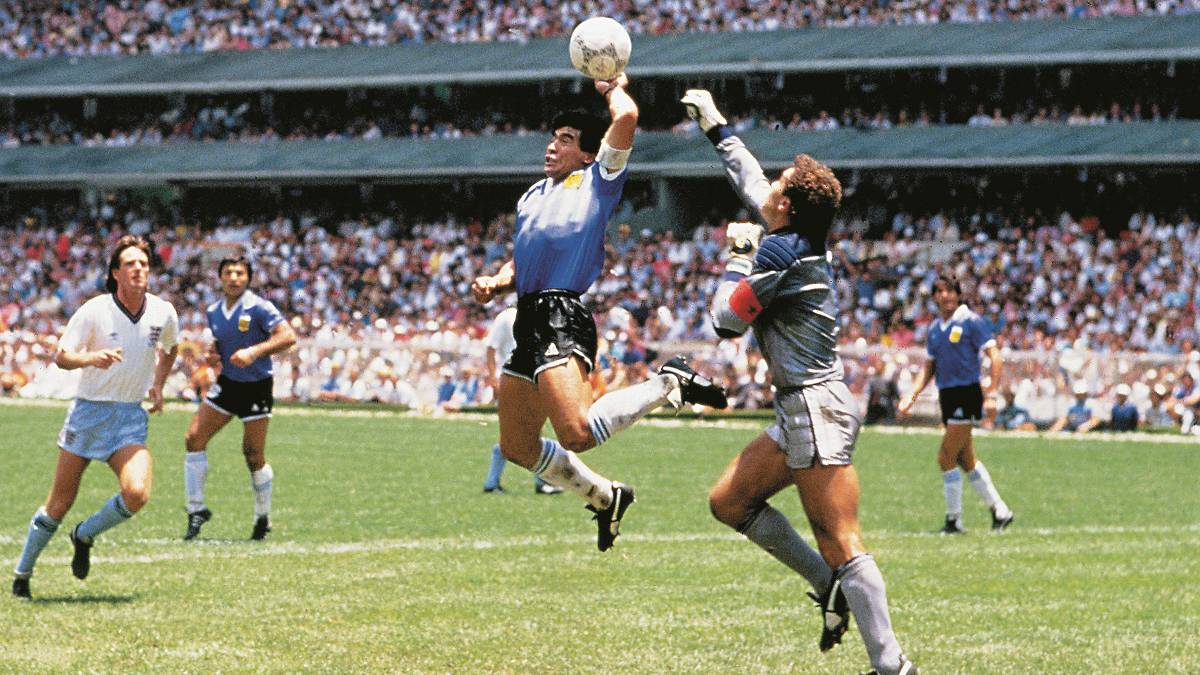

22 June 22 1986: Argentina and England faced each other at the Azteca stadium, during the World Cup in Mexico; the Falklands war was over, and the warfare inevitably slipped into the climate of the momentous football match. After five minutes and 26 seconds played in the second half, in the dynamics of the game, Diego Maradona was in an offside position, but the bad action of the defender enables him correctly and the ball falls into the penalty area. The Argentina captain went in search of the ball, jumping alongside goalkeeper Peter Shilton. The goalkeeper rises with his right fist extended, at the same time that Maradona does it with his left arm, close to his head, hidden in the technical gesture, and strikes the ball before his opponent, directing it towards the goal. Maradona began to celebrate, while looking at the assistant referee Bogdan Dotchev, who did not indicate anything abnormal. Tunisian referee Ali Bennaceur was poorly positioned: players screened him and Maradona's own head was hiding his mischief. Consequently, he delegated the responsibility to his referee teammate. Given the uncertainty and the lack of any assistance from his colleague Dotchev, who did not offer any signal and ran towards the halfway line, and despite the protests of the English players, Bennaceur, decided not to cancel what he had not seen and awarded the goal that was immortalized as "The hand of God". Of course, the goal was poorly validated, but the VAR technology would only arrive with the new century. Just as it happened on the pitch, the referee justified his mistake by trust towards his linesman. This was reflected in his release before the authorities: “I was waiting for Dotchev to give me a clue of what exactly had happened, but he did not point to the hand. And the instructions that FIFA gave us before the game were clear: if a colleague was in a better position than mine, I had to respect his view.” FIFA never clarified during the competition whether the goal had been scored illegally, as the images proved, but the Tunisian did not referee any more matches at the World Cup. 


The referee of the match, played on 30 July 1966, at the legendary Wembley Stadium, was the Swiss Gottfried Dienst, while one of his assistants that afternoon was the hesitant Soviet linesman Tofik Bakhramov. Both were absolute protagonists of a wrong decision. The stopwatch marked 11 minutes into the first overtime when local striker Geoff Hurst fired a powerful shot past goalkeeper Hans Tilkowski, the ball crashed violently into the crossbar and hit the goal line without entering the goal. However, the referee, who did not observe the action well, decided to consult what happened with his linesman, while the players stood waiting for the decision. Both agreed to award the goal, which years later was going to receive the title "ghost goal", so that England went up 3-2 on the scoreboard and headed for what would be their first and only World Cup title. In 1995, following a thorough study, the University of Oxford reported that the ball was missing six centimeters to cross the goal line, which became one of the most grotesque goals in history. 


In the first match of the Brazilian team against Sweden in Group B, an unusual situation occurred: when the score was tied, the Welsh referee Clive Thomas awarded a corner kick to Sweden a few seconds from the end. Zico executed the corner and kicked the ball at the same time that the referee decided to whistle the end of the match. The stadium was speechless to see that while the final whistle still sounded the ball slipped into the goal of Sweden. The goal was not allowed. That tie put Brazil in trouble from the start of the tournament and, despite finishing as second in Group 3, behind Austria, they would end up being eliminated in the second phase. 


The two teams were equal, 1-1, when, after 60 minutes, the German goalkeeper Harald Schumacher came out to play a contested ball with the Frenchman Patrick Battiston. However, in his intention to find and play the ball, he ended up hitting the French player’s head, a clear fact of serious foul play, forcing Battiston to leave the field on a stretcher. The referee, the Dutchman Charles Corver, not only did not send off the goalkeeper for the unsporting act, but he did not even sanction the foul as he awarded a goal kick for the Germans. After 90 minutes, both teams were still tied, so with a 3-3 result they had to decide the ticket to the final through a penalty shootout, in which Germany prevailed 5-4. 


The host South Korea played against Spain in the quarter-finals on 22 June 2002 in Gwangju. That afternoon, the Egyptian referee Gamal El-Ghandour was going to have a nightmare performance, having annulled two goals of Spain. After invalidating the first goal converted by Ruben Baraja, alleging that there was a previous foul of the player at the time of the action, the referee made a very serious error in the second goal annulled when he grossly understood that the ball had left the field of play before it ended up in the back of the net. The ball actually never left the field and Spain, which equaled 0-0 in regular time, ended up being eliminated on penalties. This widely discussed errors in the media caused the President of the Spanish FA, Villar, to resign from the Referees Committee. 


On 27 June 2010, Uruguayan referee Jorge Larrionda made one of those mistakes that will remain in the World Cup history. After Germany took a 2-0 lead on the scoreboard, England was able to react quickly with a goal from Matthew Upson. One minute after the break, Frank Lampard had a shot, the ball hit the crossbar and clearly hit the ground inside of the goal line. But the goal was never validated. The assistant referee Mauricio Espinosa, also Uruguayan, did not raise his flag and Larrionda continued the game. The speed of the action and the position of the assistant did not allow him to observe that the ball had entered the goal completely. Without the goal awarded, Germany led by Joachim Low took advantage of England's desperation and won 4-1 to advance to the next phase. 


One of the most outrageous moments in World Cup history was in Spain 1982. The protagonists: Sheikh Fahid Al-Ahmad Al-Sabah from Kuwait and Soviet referee Miroslav Stupar. The score was 4-1 in favour of France, thanks to goals from Genghini, Platini, Six and Bossis. The game was a formality for the French against a lower team; however, after 89 minutes and after the last goal by those in blue, a scandal broke out. The Asian defense was inexplicably stopped believing that a whistle had blown from the pitch. From the box, a man in a robe and turban stood up and began to make clear hand gestures, inviting the Kuwaiti national team players to leave the field. It was Al-Sabah, president of the Kuwaiti Football Federation and brother of the emir of the small country of the Persian Gulf. Seeing that his players and the coaching staff did not understand him very well, he decided to go down and enter the field of play. The sheik addressed his players, continuing to threaten the referee. Unusually, referee Stupar annulled the goal and ordered a dropped ball. The sheik received a $10,000 fine from FIFA - a tip for him - and the referee was heavily penalized: he lost his FIFA badge and never refereed again an international match. 


Argentina missed the opportunity to earn its third star in Brazil 2014 due to a referee error in the final against Germany. The Italian Nicola Rizzoli was appointed and committed a conceptual setback by not sanctioning the clear lack of attention by goalkeeper Manuel Neuer on striker Gonzalo Higuaín. Rizzoli did not respect the protocol that must be followed to decide on the level of the applied force and its consequences. There is no doubt that Neuer was the one who initiated contact with his knee, putting Higuain's safety at risk. The recklessness, the distance and the speed that he brings without any concern and the force with which he reaches could cause even an injury to his opponent. The regulation stipulates that a reckless action, that is, the force used by Neuer on contact, will be penalized with a direct free kick or a penalty kick. At no time does it say that, being the goalkeeper and reaching the ball earlier authorizes him to run the risk of injury to the opponent or to contest the ball with disproportionate force. History will say that the German was fouled by Higuain, but the correct thing would be the sanction of the penalty and yellow card, which deprived Argentina of a possibility of going on to win the match and dream of their third gold medal. FIFA never commented on it or came up with an analysis of the play. 

A giant in African refereeing has fallen

Considered a "father" by the new generation of referees, Badara Sene died on Monday, at the age of 75, due to an illness. Former FIFA referee and former president of the CAF Referees Committee for several years, he was also mayor of the City of Rufisque (2009-2014). He was at the base of the training of most Senegalese international referees like Falla Ndoye, Badara Diatta, Malang Diedhiou and developed them during their respective careers. Badara Sene himself was the referee of the CAN 1992 final, which took place in Senegal, between Côte d'Ivoire and Ghana. (Source: SenePlus) 
According to his former colleague, international referee Malang Diedhiou, Senegal has lost a social and honest man. “He was someone who loved refereeing all his life and who held several positions of responsibility at the CAF level and in Senegal. He's an honest referee. But also a very social man. On numerous occasions, he has traveled to provide support to people,'' says Malang Diedhiou on Rfm. He added: “I remember a competition in which I had a good match and they wanted to give me another. But I had an injury. He came to see me and to give me his advice. In the end, I listened to his advice and decided not to take this match, because I was not at my best level and it could affect my career”. (Source: SeneWeb) 
Former World Cup referee Jerome Damon also paid his respects: “A giant in refereeing has fallen... today I bid a sad farewell to Badara Sene from Senegal. Badara and the late Omar Sey (GAM) gave me a chance in 2003 and sent me to WCU17 in Finland... stood with our decision when all were against us #CAN2006 CIVNGA. Mentor and friend RIP.” (Source: Twitter)

Former referee pushing boundaries

"At a time when everyone is still struggling with the pandemic, I would like to offer my support to sportspeople around the world and in particular to the wider family of referees, to which I belong," said former Beninese referee Rosalie Tempa Ndah Francois as she sat down for an interview with FIFA.com. "I’d also like to offer my sincere thanks to FIFA and CAF [African Football Confederation] for having chosen me." 
The fact is, however, that the 47-year-old Tempa has no need to thank anyone for her incredible refereeing career. "I used to watch football on TV when I was a child," she explained. "There was hardly any women’s football in Benin and I played with the boys when I was at school. It was really tough, though, and I soon gave up. And then, when I grew up, I saw that women were refereeing games." That surprise discovery showed Tempa where her future lay. Pulling her boots on again, she went back among the boys on the pitch in her neighbourhood. "People didn’t think it was right and even my family refused to support me," she said. “It was really hard. In the end, the coach suggested to me that I referee the team’s matches in training. I didn’t know anything about the laws of the game, so I just did what I could," recalled Tempa. "Everyone shouted at me (laughs). I was refereeing all on my own. There were no assistants." Her experiences prompted her to find out if she could do some training in Benin, which is when she discovered the Central Referees’ Commission and decided to take one of their courses. "That’s when I really started to learn the laws of the game. When I was doing the course, I put into practice all the things I learned on the pitch and I trained with the male referees. They were very happy to see a brave woman come and join them." Tempa needed to be brave in taking charge of matches played on poor pitches, with no fencing, and often in a very hostile environment. "You got stones thrown at you and people coming on to the pitch screaming and shouting and even getting physically violent," she said, managing to keep a smile on her face. "It was when I started training with Lions de l’Atacora, a local men’s team that I really began to believe in my abilities. Physically, I could keep up with the men and the coach congratulated me on that." In 2003, after eight years of hard work, she finally achieved her goal. Having caught the eye of CAF experts at a training camp, she became a FIFA assistant referee: "I was so happy. The newspapers were talking about me and I silenced all the doubters. My parents were very proud to see me make it (laughs)." And that was only the start. That same year, Tempa, who is also a qualified hairdresser, officiated at the African Games in Nigeria, taking charge of matches in the women’s tournament, including the final. She performed so well that she then got the call to referee at the Women’s Olympic Football Tournament Athens 2004. "It was absolutely amazing," she said. "It was my first long-haul flight (laughs). I was very proud to be representing my country and Africa in front of the whole world. I learned so much just by being around other match officials from all over the world." Tempa went on to officiate at six FIFA Women’s World Cup™ competitions (U-20 and senior), two more Olympic Games and six CAF Africa Women’s Cup of Nations. "I have lots of great memories," she added, "but if I had to pick one out, it would have to be the match for third place between Germany and Japan at the Beijing 2008 Olympic Games (a 2-0 win for the Germans)." 
"I retired in 2017 to become a referee instructor," she explained. "I was still in shape but I wanted to make way for the youngsters, to give others the opportunity that I’d had and to devote my energies to the development of women’s and African refereeing." Asked to explain what has brought her the most satisfaction in her career, Tempa replied: "To see women making their way in the game. Women’s football took a while to get going in Africa and it hasn’t developed as quickly as elsewhere. That’s why, in my eyes, there’s no better sight than a woman with a ball at her feet or a whistle in her mouth. Women who play sport can only become even more intelligent and dynamic. It also helps them to break free, travel, discover things and make friends. "Real change is happening here in Benin," she continued. "The example I set has inspired lots of girls who have met with me and spoken to me. I give training courses and we talk a lot. The best piece of advice I can give them is to not lose heart and to work hard towards their objectives. They also need to ignore people who think that women in Africa are only there to have children and cook." As well as her football activities, Tempa runs a hairdressing college and a charity by the name of ACAL-DR. It organises open-air movie screenings in rural communities to raise awareness about development best practice and other issues, such as schooling for girls, violence towards women, birth registrations, child abuse and bullying. Whether it is on the pitch or off it, Rosalie Tempa Ndah Francois is one of those people who is always pushing boundaries. 

Source: FIFA

Former top referee Snoddy to release autobiography

Former referee Alan Snoddy is writing an autobiography about his career in football. From making his bow in a Churches League game between Lowe Memorial and Bourneview Young Men back in 1972, Alan went on to spend 25 years in the Irish League where he became one of the top officials in the country. He was also a FIFA referee for two decades - working at successive World Cups in Mexico (1986) and Italy (1990) - before going on to become a technical instructor with both FIFA and UEFA.
His refereeing career spanned over 40 years, offering a lifetime of memories which he hopes to condense into a book to be released later this year. "I am not an author, obviously. But the original ideal was that I would start off with some memories of a lifetime in refereeing," Alan said. "As it developed, I am getting other people's memories included in it as well, and I am just trying to tell the story of my life. I have kept a notebook from the very first match I refereed in. Notes of the game, the date, the score, where it was played. And without that I would be struggling," he said. "I was involved in over 1600 games so it is pretty difficult to remember every single one. I was approached by a publisher quite a while ago through LinkedIn. At that time I just simply didn't have the time to sit down and write a book. And I had never thought about writing a book, to be honest. They just said that from looking at my profile, that I had a story to tell. So the idea sort of floated around, and they would have sent me the odd email asking if I had thought any more about it. I would have said yes but I was still too busy. Then Covid-19 hit us, and I thought if I was ever going to do it, it was now. So I got back to the publisher and said yes. We had a nice conversation and discussed things and I got stuck in. It is virtually most nights of the week, I sit down and write something. I only started the process in April."
Alan admits football today is much changed from the era when he was in the middle. "Twenty years ago the game was much more physical than it is now, yet we had less yellow cards then than referees are expected to give out now," he said. "So it has changed in that respect. There are a lot of cautions given now for technical things, things that if they had happened back then you probably would just have given a warning. Or the free-kick would have been taken the game would roll on. I am not saying the yellow cards these days are wrong, they're not. But the game has changed in that way.” Since retiring from refereeing in 2003, Alan's experience has been in demand all across the world. He was Referees' Manager with the Irish FA for eight years where he helped with recruitment and development, and has worked as a technical instructor with both FIFA and UEFA. He has also worked in Latvia and Cyprus, and has done significant work with UEFA's Centre of Referee Excellence. But does he miss being the man in the middle on match day? "I suppose part of me misses refereeing, but at the same time I had 32 years. I was never injured or had to cry off a game," he said. "I have a lot to be thankful for, and I got to choose when to stop. I can't be greedy about things, I had a fantastic run. It was the right time to stop when I did, and move onto the next chapter." Alan anticipates a busy summer of work and writing as he looks to get his autobiography published by the end of the year. "We are aiming for the end of this calendar year. Hopefully around Christmas time," he added. "I need a target to get it done and dusted, and have something to aim for. So Christmas is a realistic objective."

Source: BelfastLive

Stunning goal-line technology failure

Hawk-Eye have apologised after goal-line technology failed to award Sheffield United a goal during their clash with Aston Villa as the Premier League resumed with huge controversy. Orjan Nyland back peddled after catching Oliver Norwood’s floating free-kick, with replays clearly showing the ball had crossed the line. The Sheffield United players immediately protested, but referee Michael Oliver’s watch did not react and play continued. VAR still could have intervened and spared the technology’s blushes but no review was ordered. And the situation was made even more extraordinary when reports surfaced that Oliver’s watch had gone off – during half-time. 
The technology failed for the first time since it was introduced in the Premier League in 2013. A statement from Hawk-eye Innovations, who run the technology, after the match read: “During the first half of Aston Villa v Sheffield United match at Villa Park, there was a goal line incident where the ball was carried over the line by Aston Villa goalkeeper, No. 25 Nyland. The match officials did not receive a signal to the watch nor earpiece as per the Goal Decision System (GDS) protocol. The seven cameras located in the stands around the goal area were significantly occluded by the goalkeeper, defender, and goalpost. This level of occlusion has never been seen before in over 9,000 matches that the Hawk-Eye Goal Line Technology system has been in operation. The system was tested and proved functional prior to the start of the match in accordance with the IFAB Laws of The Game and confirmed as working by the match officials. The system has remained functional throughout. Hawk-Eye unreservedly apologises to the Premier League, Sheffield United, and everyone affected by this incident.” 

Source: Football365

Martin Strombergsson accused of racism

Swedish referee Martin Strombergsson has been suspended after expressing his disdain for Östersund goalkeeper Aly Keita. SVT Sport has been in contact with Strömbergsson, who explains the event in an open letter. "I want to state that I had no mean or racist idea with my way of expressing myself," he writes. 
Goalkeeper Aly Keita confessed that referee Martin Strömbergsson had said to him: "Go back to your goal so they can throw bananas at you" during a match against Gif Sundsvall last season. Strömbergsson has been suspended pending investigation. “It's unacceptable. You have to think about what you say”, referee Stefan Johannesson tells SVT Sport. Martin Strömbergsson, who is very remorseful, could not stand up for an interview because it would be far too emotional at the moment. He claims that the expression is a foolish one. “There is not a single gene in my body that has had any nasty or racist backing with what I expressed to Aly Keita a year ago. Instead, I have used a phony-like expression without considering the skin color, background or culture of the player. I immediately apologized during the match, followed up with a call in the change room after the final whistle, met Aly Keita in a match a few weeks later and once again followed up the incident and apologized for my crippled and unedited expression. It's so far from my personality and my values ​​as you can get". 

Source: SVT Sport

Referee Verissimo tests positive again

Portuguese referee Fabio Verissimo again tested positive for Covid-19 and will be replaced by Hugo Miguel at the closing match of the 27th round of the 1st football league, between Famalicao and Sporting de Braga.
According to the note published on the website of the Portuguese Football Federation (FPF), the referee from Leiria, 37, who had returned to training in early June, “obtained four negative results before being nominated for the first time”.

Source: SAPO

UEFA competitions to resume in August 2020

UEFA Champions League 2019/20
· Quarter-finals, semi-finals and the final will be played as a final eight straight knock-out tournament at the Estádio do Sport Lisboa e Benfica and the Estádio José Alvalade in Lisbon between 12 and 23 August 2020.
· The remaining Round of 16 second-leg matches will be played on the 7/8 August, pending a decision on whether they will take place at the home team’s stadiums or in Portugal. The Estádio do Dragão in Porto and the Estádio Dom Afonso Henriques in Guimarães will be added to Lisbon venues for the Round of 16, if necessary.
· Quarter-finals will take place on 12/13/14/15 August, semi-finals on 18/19 August and the final at the Estádio do Sport Lisboa e Benfica on 23 August. All remaining matches of the 2019/20 UEFA Champions League will kick-off at 21:00CET.
· The draws for the 2019/20 UEFA Champions League quarter-finals and semi-finals will take place on 10 July 2020 at UEFA’s headquarters in Nyon and the exact match schedule will be communicated following such draw. All quarter-final and semi-final matches will go to extra-time and penalty kicks in case of a draw at the end of the regular playing time. The same regulatory change will likewise apply to matches in the other competitions for which the same decision has been taken.
· Istanbul, which was originally appointed to stage the 2020 final will now host the 2021 UEFA Champions League Final, whereas the venues for subsequent finals have all agreed to host these a year later than originally planned, with St-Petersburg in 2022, Munich in 2023 and London (Wembley) in 2024.

UEFA Europa League 2019/20
· Quarter-finals, semi-finals and the final will be played as a final eight straight knock-out tournament in Cologne, Duisburg, Düsseldorf and Gelsenkirchen between 10 and 21 August.
· The Round of 16 matches will be played on 05/06 August with kick-off times of 18.55CET and 21.00CET. A decision will be made in due course on whether the Round of 16 matches for which the first leg has already been played will be staged at the home team’s venue or in Germany. The matches FC Internazionale Milano v Getafe CF and Sevilla FC v AS Roma, whose first leg was also postponed, will be played as a single leg at a venue to be confirmed.
· All subsequent matches in the competition will be played as a final eight tournament, with quarter-finals on 10/11 August, semi-finals on 16/17 August and the final in Cologne on 21 August, all kicking-off at 21:00CET.
· The draws for the 2019/20 UEFA Europa League quarter-finals and semi-finals will take place on 10 July 2020 at UEFA’s headquarters in Nyon and the exact match schedule will be communicated following such draw.
· Gdańsk, which was originally appointed to stage the 2020 final will now host the 2021 UEFA Europa League Final, whereas the venues for subsequent finals have all agreed to host these a year later than originally planned, with Sevilla in 2022 and Budapest in 2023.


UEFA Women’s Champions League 2019/20
· All remaining matches in the competition will be played as a final eight straight knock-out tournament at the San Mamés Stadium in Bilbao and the Anoeta Stadium in San Sebastián, with quarter-finals on 21 (18:00CET) and 22 August (20.00CET), semi-finals on 25/26 August at 20.00CET and the final taking place in San Sebastián on 30 August at 20.00CET.
· A draw will also take place at UEFA in Nyon on 26 June to determine the order of matches and the final match schedule will be communicated following such draw.
· The UEFA Women’s Champions League finals of the coming years will take place in Gothenburg (2021), Turin (2022) and Eindhoven (2023) as originally planned.

UEFA Youth League 2019/20
· The remaining Round of 16 match(es) (pending the outcome of disciplinary proceedings on FC Internazionale Milano v Stade Rennais FC) will be played on 16 August in Nyon, and a final eight tournament will be staged at the Colovray stadium in Nyon between 18 and 25 August 2020. Quarter-finals will take place on 18/19 August, semi-finals on 22 August and the final on 25 August.

UEFA Super Cup 2020
· The 2020 UEFA Super Cup which was originally due to be hosted by Porto, will now be played at the Puskás Aréna in Budapest on 24 September 2020 at 21.00CET.
· The following editions of the UEFA Super Cup will take place as originally scheduled in Belfast (2021), Helsinki (2022) and Kazan (2023).

UEFA club competitions 2020/21
· The access lists for the 2020/21 UEFA Champions League, UEFA Europa League, UEFA Women’s Champions League and UEFA Youth League have not been affected by the new calendar.
· The deadline for national associations to enter teams to the competitions will be 3 August for the UEFA Champions League and UEFA Europa League; and 10 August for the UEFA Women’s Champions League.

UEFA Champions League/UEFA Europa League 2020/21
· In order to achieve the necessary separation with the final phase of the 2019/20 season and avoid impact on the access list and on clubs potentially involved in both competition phases, the qualifying rounds of the two competitions will be played in single legs (instead of home and away), with the only exception of the UEFA Champions League Play-offs which will remain over two legs. The draw will determine which club will play the single leg in their stadium.
· The group stage draws for the 2020/21 UEFA Champions League and UEFA Europa League will take place in Athens at the Stavros Niarchos Foundation Cultural Centre on 1 and 2 October 2020 respectively.

UEFA Women’s Champions League 2020/21
· The qualifying round mini-tournaments will be played between 7 and 13 October, the Round of 32 will be played on 11/12 and 18/19 November, the Round of 16 on 3/4 and 10/11 March, the quarter-finals on 23/24 March and 31 March and 1 April, the semi-finals on 24/25 April and 1/2 May and the final on 16 May 2021 in Gothenburg.
· The qualifying round draw will take place at the House of European Football in Nyon in the first week of September.

UEFA Euro 2020
· The 12 original host cities have been confirmed as venues for the final tournament in the summer of 2021 and consequently the updated match schedule was also approved. All existing tickets remain valid for the tournament in 2021. Existing ticket buyers who nevertheless wish to return their ticket(s), will have a final opportunity to request a refund from 18 June to 25 June via euro2020.com/tickets. Dates for potential future ticket sales including for fans of the four teams that will qualify via the play-offs will be confirmed at a later stage.

European Qualifiers Play-Offs and 2020/21 UEFA Nations League Group Stage
· The national team football windows of October and November 2020 will now feature triple-headers instead of double-headers, thus allowing the postponed European Qualifiers Play-Offs to be rescheduled at the beginning of the respective windows, on 8 October and 12 November.
· The group stage matches of the 2020/21 UEFA Nations League will be played on the following matchdays: 3/4/5 and 6/7/8 September; 10/11 and 13/14 October; 14/15 and 17/18 November 2020.
· Friendly matches will be played on 7/8 October and 11/12 November.
· The fixtures with confirmed dates and kick-off times will be announced in due course on UEFA.com

2019/21 UEFA European U-21 Championship
A new format was approved with the final tournament being split over two periods, with the original venues of Hungary and Slovenia still hosting both parts of the final tournament. The qualification competition that is currently underway will finish in September, October and November 2020. The nine group-winners and the five best runners-up will be joined by hosts Hungary and Slovenia for a group stage of four groups of four from 24 to 31 March 2021, with groups hosted by Hungary and by Slovenia. The four group-winners and the four runners-up will then qualify for the final tournament which will be played as a straight knock-out final eight (quarter-finals and semi-finals in Hungary and Slovenia and the final in Ljubljana) from 31 May to 6 June 2021.

2019/20 UEFA European Women’s U-17 Championship
The Elite Round will take place between 12 and 20 September, whereas there will be a final eight straight knock-out competition from 4 to 10 October. The tournament, which serves as qualification to the FIFA WU-17 World Cup, will be hosted by Sweden pending final confirmation.

2019/20 UEFA European U-19 Championship
The Elite Round will take place between 31 August and 8 September. The final tournament will be split over two periods. A group stage featuring two groups of four teams will be held between 8 to 14 October in Northern Ireland. The two group-winners and the two runners-up will qualify for the finals, whereas the two third-placed teams will participate in a play-off match to determine the fifth team qualified for the FIFA Under-20 World Cup. All such final matches will be played in Northern Ireland between 09 to 18 November.

2019/20 UEFA Futsal Champions League
The UEFA Futsal Champions League Finals will be played in Barcelona with semi-finals, a third-place play-off and the final from 8 to 11 October. Minsk which was originally appointed to host the 2020 finals will now host next year’s finals in April 2021.

2020 FIFA Futsal World Cup
The play-offs have been rescheduled between 2 and 11 November 2020.

UEFA Futsal Euro 2022
The qualifying rounds play-offs will take place between 2 and 11 November, whereas the group stage and play-offs will be played between 6 December 2020 and 17 November 2021.

UEFA Women’s Futsal Euro 2022
The preliminary round will be played between 4 and 9 May 2021; the main round between 19 and 24 October 2021; the finals between 24 to 27 March 2022.

UEFA Futsal U-19 Final Tournament 2021
The final tournament will take place between 1 and 7 November 2021.

2020/21 UEFA Regions’ Cup
The 2020/21 edition of the competition has been cancelled.

2020-22 UEFA European U-19 Championship
The introduction of the recently approved new format with teams split into three different leagues with promotion and relegation and a final tournament involving eight teams in the summer of 2022 has been postponed to the 2021/23 edition of the competition. Consequently, there will be a 2021-22 UEFA European Under-19 Championship played under the standard format that had been used until now.

Source: UEFA

Referees threatened after Belarusian Premier League match

A group of referees were stopped on the roadside and threatened after overseeing a draw between the top two teams in the Belarusian league, said the national football federation.
The incident happened when the referee and his assistants were travelling by car with the match inspector following Sunday's 2-2 draw between leader Bate Borisov and second-place Shakhter Soligorsk, the federation said. A vehicle containing unknown people apparently braked sharply to force the officials' car to stop. The referees were then ordered out of the car, and "insulted and threatened" with reference to the game between Bate and Shakhter, according to the federation. The federation called the incident "categorically unacceptable". It said that a video recording from the dashboard camera in the referees' car could be passed on to authorities as evidence. Belarus has long struggled with attempts to manipulate or influence the outcome of games, and the federation has regularly banned players for match-fixing.

Source: Yahoo

MLS is Back: It will be difficult for non full-time officials to participate

Major League Soccer has announced plans to return to action in Orlando next month in a 26-team round-robin tournament that will kick start the 2020 season. The event, similar to the format of the FIFA World Cup, is the culmination of months of detailed and evolving conversations since the initial suspension of play on March 12. During that time, PRO GM Howard Webb has explained how the organization has adapted to lockdown protocols, and how preparations for a return to refereeing in such extraordinary circumstances have developed. “I don’t think we are going to see any changes to the way the game is played; tackling is tackling, heading is heading, and officiating is officiating – that will need to take place in a normal way,” Webb said. “The games are meaningful and there will be a lot of eyes on them when we go live on TV. We’ve seen how much attention has been paid to the Bundesliga, so the games will need to be officiated to a high level and that is what we expect from our group. We have been making sure our officials are as ready as possible to perform on the field, getting back to those full levels of fitness. Only PRO referees who regularly officiate in MLS are full-time and many of our other officials who serve as ARs and VARs are also employed in other professions. This may make it difficult for some of them to work in this tournament. The initial feedback we’ve had has been positive about numbers. We’ll try to create as many opportunities as possible for everybody who is available; they’re keen to get back on the field and get started again. We’ll keep working with the others who can’t be there, who have to stay in their home markets for whatever reason, family or work, making sure they stay fully in contact with us and continue to utilize training facilities to keep them as sharp as possible.”
Video Review will be in operation when MLS returns but dialogue will continue as details are ironed out regarding other aspects of game day to determine what short-term adjustments are required from a safety perspective. “We value Video Review in our competition and we feel it plays an essential part; as such we are delighted it will be in use throughout the MLS is Back tournament. Of course, we are still dealing with COVID-19 and measures will be implemented to ensure that unnecessary risks aren’t taken, pregame handshakes, for example, probably won’t happen. We’re also seeing some other adjustments that will be introduced, such as the utilization of additional numbers of subs. These are sensible things to implement given the length of time players have been away from competitive soccer. With the games being played in Orlando and the heat at this time of year, we will also need to consider water breaks at appropriate times. We are not just talking about reacting to changes in protocol, but how we can be proactive in preventing problems.” Although soccer will one day return to what we have been used to seeing prior to the pandemic, some behind-the-scenes operations may not; the lockdown forcing changes to how organizations work. “Some of the things we’ve been trying out we would never have done without being forced to do so,” Webb added. “It is quite likely we will come out of this with some new practices that we’ve seen work well and will want to continue. We’ll reflect at the end of this and get opinions on it. We value face-to-face contact, but if we find another way of bringing people together without having to fly them to meetings, that reduces the downside of additional travel. We have to weigh it all up. We might also look back and see we made the best of it while we could, but actually, it was better the way we worked before. That might be an outcome, but there will definitely be a period of reflection, and there may be some changes coming out of it afterwards.”

Source: PRO